2025: The Year Hollywood Died, Except for This One Movie
Let’s not sugarcoat it. 2025 has been a total catastrophe for big-budget cinema, a graveyard of forgotten blockbusters where a sequel to a sequel about a superhero nobody cares about anymore struggles to even break even against its inflated marketing budget, while anything original gets completely ignored by a viewing public that has clearly decided staying home in pajamas is preferable to paying thirty bucks for a soggy hotdog and a ticket to something mediocre, a truly sad state of affairs for anyone who remembers the good old days when going to the movies was an event, not a chore.
You see, the theatrical release model is absolutely on life support, gasping for air, so when a movie actually manages to cut through the noise, to actually make a dent in the box office—and I mean really make a dent, not just limp across the finish line—you have to sit up and take notice, especially when that movie is a remake. Because let’s be honest, remakes are almost always hot garbage, a lazy attempt to cash in on nostalgia by people who have clearly run out of ideas, but every once in a while, a creative team comes along and actually figures out how to update a classic without completely screwing it up, which brings us to *The Running Man* (2025).
The Arnold Era: A Campy Masterpiece or Just a Mess?
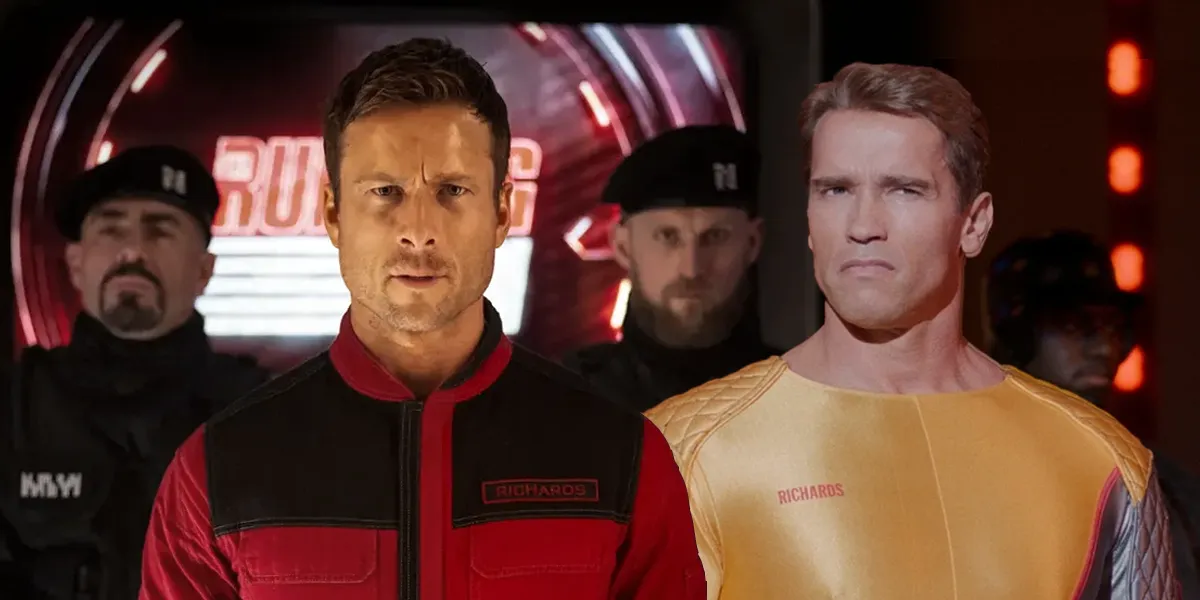
Now, before we get into why the new film is a certified banger, we have to look back at the original from 1987 (and I know some of you are already sharpening your knives, but hear me out). The 1987 version, starring Arnold Schwarzenegger (the undisputed king of one-liners at the time), is undeniably iconic; it’s a pure, unadulterated slice of 80s action cheese, where the villains are cartoonishly evil and the social commentary is delivered with all the subtlety of a sledgehammer to the face, which, let’s face it, is exactly what we expected from an Arnold movie at that point in his career. The original *Running Man* completely threw out the darkness and nuance of Stephen King’s novel, replacing the grim, satirical vision of a truly dystopian future where the lines between reality TV and state control blurred with high-octane action sequences, ridiculous costumes, and a villain who looked like he belonged in a wrestling ring, not running a fascist state.
It was, for lack of a better term, a spectacle of excess, and while it certainly holds a place in the hearts of those who grew up in that era, it always felt like a missed opportunity to truly explore the horrifying implications of King’s story. The original was all about the spectacle, and frankly, it felt dated even by 1987 standards. The new film (and this is where I start getting controversial) actually understands the source material in a way the original never did; it’s less about the action hero and more about the psychological terror of a society obsessed with spectacle, something that resonates far more deeply in a world where we essentially stream our own lives on social media and a single misstep can ruin a reputation overnight, transforming a person’s life into a public spectacle for the entertainment of others. The 1987 film felt like a fun action movie with a dystopian coat of paint; the 2025 version feels like a truly terrifying prophecy unfolding right before our eyes, a mirror held up to our own addiction to online validation and schadenfreude.
The Glen Powell Effect: From Maverick Wingman to Dystopian Hero
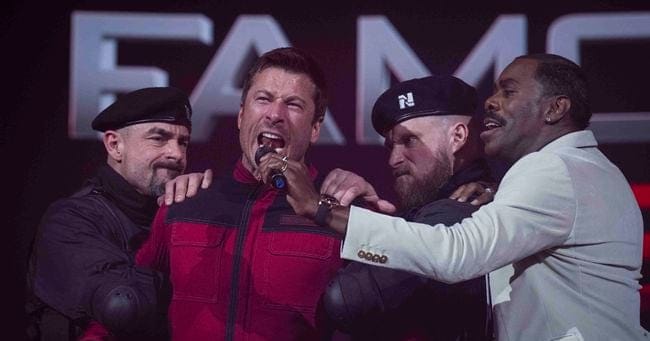
Enter Glen Powell. Now, I love Arnold, I really do, but let’s be honest, he wasn’t exactly known for his subtle acting during the peak of his action career (his lines were more about setting up the next explosion than delivering deep emotional resonance), so a remake needed to pivot completely away from that larger-than-life action star persona. The new film, with Powell at the helm, finally gives us a protagonist that feels like a real person—a genuinely desperate individual caught in a system, not just a muscle-bound commando looking for a fight; this is a much better fit for the source material, which demands a more grounded approach to the character’s plight. Powell brings a vulnerability and a genuine intensity to the role that elevates the material far beyond what the 1987 version ever attempted, proving that sometimes a shift in tone and casting is exactly what a remake needs to separate itself from its predecessor, even when the predecessor is a cult classic.
The 2025 film’s success isn’t just about good casting; it’s about timing. When we look at the box office, we can see that *The Running Man* (2025) managed to pull off something truly remarkable in a year when almost every theatrical release has struggled, demonstrating that audiences are hungry for intelligent science fiction that actually has something to say about the world we live in. It actually managed to pass Harrison Ford’s forgotten war movie at the box office, which, let’s be real, is not exactly a high bar given the current state of things, but it’s still significant. Harrison Ford’s film (which shall remain nameless because frankly, nobody remembers it) was another example of a studio relying on an established star and a familiar genre without actually providing any new insights or genuine thrills; it was exactly the kind of formulaic content that audiences have completely rejected in 2025, proving that a name alone isn’t enough to guarantee success anymore. Powell’s *Running Man*, on the other hand, had a strong concept and a timely message, allowing it to succeed where the bigger-budget, star-driven vehicles failed.
A Tale of Two Societies: Why the Social Edge Matters
The core difference between the 1987 version and the 2025 version (as noted in the input data) comes down to “social edge.” The 1987 film’s critique of media manipulation felt quaint; the 2025 film’s critique feels terrifyingly accurate. In the new film, the games are broadcast live not just on television but across immersive digital platforms, with real-time audience interaction and commentary, mirroring exactly how social media platforms function today. The film effectively uses high-octane action to frame a deeper, more sinister critique of a society that monetizes human suffering for entertainment, creating a visceral experience that hits closer to home than anything the 80s version could have achieved. The original film felt like a fun action movie where the hero overcomes a dystopian system; the new film feels like a horror movie where the system itself is the true monster, consuming both the hero and the audience.
Now, I know some purists will always argue that the original is better simply because it came first, or because it has that certain nostalgic charm, but frankly, nostalgia isn’t enough to make a good movie, especially when you’re adapting a dark source material like King’s novel. The new *Running Man* isn’t just better; it’s *smarter*. It manages to take the core concept of the original novel and update it for a world where reality television has become a staple of human entertainment and where the very concept of privacy has been completely obliterated by digital platforms, making the 1987 version look like a simple, somewhat naive precursor to a much more complex and disturbing reality; it’s a terrifying look in the mirror for us all. The original film was a product of its time; the new film is a commentary on ours. This isn’t just a win for Glen Powell; it’s a win for intelligent cinema in-depth filmmaking in a landscape dominated by empty spectacle. It’s exactly what the genre needed, and frankly, what cinema itself, needs right now.