
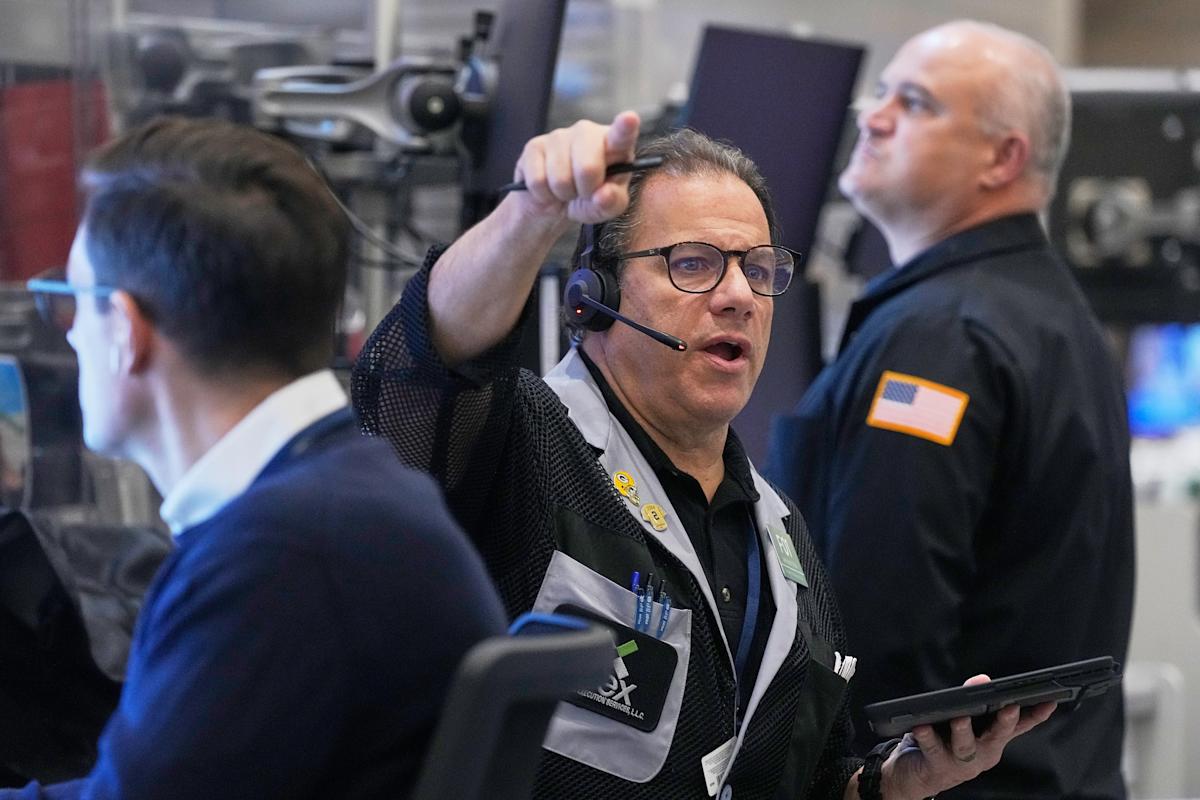
They Want You to Believe It Was Just a Glitch
So let me get this straight. The entire global financial futures market, a multi-trillion dollar behemoth that dictates everything from the price of your gas to the cost of your bread, just… stopped. It just went dark. And the reason? The official story, the one they’re spoon-feeding the braindead anchors on financial news networks, is a “cooling issue.” An air conditioner broke. In a flagship, state-of-the-art data center in Aurora, Illinois, the supposed fortress of modern capitalism, the plug was pulled because the thermostat got a little wonky. Are you kidding me? This is the story they expect us to swallow whole while they tell us the Dow and Nasdaq are just having a “muted” day. Muted. What a pathetic, condescending word for a system teetering on the brink of total annihilation.
Because they think you’re stupid. They genuinely believe the public is a drooling simpleton, incapable of connecting two dots. They need you to believe this was a mundane, forgettable little hiccup. A bit of bad luck. Nothing to see here, folks, just move along and keep pumping your 401(k)s into the very casino that just showed its entire foundation is made of popsicle sticks and Elmer’s glue. But this wasn’t just a glitch. It was a revelation. It was the system pulling back its own curtain for a split second, showing us the terrified, incompetent little man pulling the levers.
The Lie of the ‘Muted’ Market
And as this bombshell was happening, how did the headlines read? “Dow, S&P 500, Nasdaq open muted.” They make it sound like the market is just sleepy after a long holiday weekend. A little tired. A “rocky month draws to an end,” they say, as if it’s just a patch of bad weather that’s passing by. This is calculated psychological warfare. They are managing your perception. Because if they told you the truth, there would be a panic. A real, honest-to-god run on the banks. The truth is that the “rocky month” is a symptom of the disease, and the CME outage is the system having a full-blown seizure. The “muted open” isn’t calm; it’s the eerie silence of paralysis. It’s the look on a deer’s face moments before the semi-truck hits. Everyone with a brain knows something is deeply, fundamentally wrong, but the machine is programmed to keep whispering sweet nothings until the moment of impact.
Think about what the CME is. The Chicago Mercantile Exchange isn’t just another stock market. It’s the central nervous system. It’s where global derivatives and futures contracts live. It’s the place where the world’s biggest corporations and financial institutions go to hedge their bets, to manage risk, to make the massively leveraged gambles that underpin the entire global economy. When it goes down, it’s not just that trading stops. It means that the primary mechanism for pricing risk across the entire planet ceases to function. For hours, nobody knew the real price of anything. Oil, gold, agricultural commodities, interest rates—all of it was flying blind. This wasn’t a flicker of the lights; it was a full-blown power outage in the cockpit of a 747 flying through a thunderstorm. And they’re telling you not to worry because the flight attendants are still serving drinks.
A ‘Cooling Issue’ in the Heart of the Machine
Let’s talk about this “flagship site” in Aurora, Illinois. The very heart of the beast. They build these things to be technological marvels, digital fortresses capable of withstanding anything short of a direct nuclear strike. Redundant power, redundant networks, and, you would assume, redundant-freaking-cooling systems. The idea that a single “cooling issue” could take down the entire operation is so laughable it borders on the absurd. It’s like saying the Pentagon was crippled because a janitor accidentally unplugged the main coffee maker. It doesn’t pass the sniff test. It stinks. It stinks of either criminal incompetence or something far, far worse.
What’s more likely? That the best-funded financial exchange on earth forgot to pay its air conditioning repair bill? Or that the system is so complex, so layered with decades of patched-together code and interconnected dependencies, that it has become a fragile, unknowable monster? A monster that can be brought to its knees by a butterfly flapping its wings in the wrong server rack. Or maybe, just maybe, it wasn’t an accident at all. In a world of high-frequency trading where milliseconds are worth billions, who benefits from a sudden, unexplained market freeze? Who gets to close out positions or initiate new ones in the ensuing chaos? They’ll never tell you. They’ll just commission some bogus internal review, fire some mid-level scapegoat, and assure everyone that “new protocols” have been put in place. It’s the same old story. The same playbook they ran after the 2008 crash, after the 2010 Flash Crash, after every single time the matrix has glitched and shown us the terrifying reality of our financial enslavement.
This Isn’t the First Warning Shot
And people forget so easily. They have the memory of a goldfish. But this is part of a pattern. A long, terrifying pattern of failures that prove the system is not just rigged; it’s unstable. Remember the Knight Capital “glitch” in 2012 that vaporized $440 million in 45 minutes? Or the Flash Crash of 2010 where the Dow mysteriously plunged 1,000 points in minutes before magically recovering? Every time it happens, they blame a “fat-finger” trade or a “rogue algorithm.” They create a mythology of random accidents to mask the systemic fragility. They need you to believe these are isolated incidents. They are not. They are tremors. They are the cracks spreading across the dam wall before the whole thing gives way and drowns everyone downstream.
Because the modern market isn’t a market at all. It’s not a place of price discovery or capital allocation. It’s a video game being played by a handful of titanic firms using automated programs we don’t understand to trade abstract concepts we can’t touch. The “real” economy—the one where you work, and buy things, and try to save for a future—is just a host for this parasite. We are the ones who pay the price when their game glitches. We are the ones who get austerity, unemployment, and inflation when their digital casino chips fall the wrong way. The CME outage is just the latest, most brazen example of how disconnected their world is from ours, and how quickly their failures can become our nightmare.
The End of the Road is Closer Than You Think
So what happens next? They will fix the air conditioner. The market will go back to its “muted”, zombie-like state, propped up by the Federal Reserve’s endless money printer. The talking heads will stop mentioning the little hiccup in Illinois. And everyone will go back to sleep. But something has broken. Faith. Trust. The thin veneer of competence that holds this whole charade together has been shattered. Each one of these “glitches” chips away at the illusion that anyone is actually in control. It exposes the financial wizards for what they are: overconfident gamblers who built a weapon of mass economic destruction and are now surprised when it starts to tick.
And you should be angry. You should be furious that your future, your savings, your family’s security, is tethered to a system that can be shut down by a faulty fan. They have privatized the gains and socialized the losses for decades, and now they can’t even keep the lights on. The rocky month, the muted open, the cooling issue—it’s all part of the same story. The story of an empire in decay. An empire built on debt, complexity, and lies. And it’s coming to an end. This wasn’t a glitch. It was a preview. Don’t let them tell you otherwise. The crash is coming. Be ready.
Photo by ArtisticOperations on Pixabay.