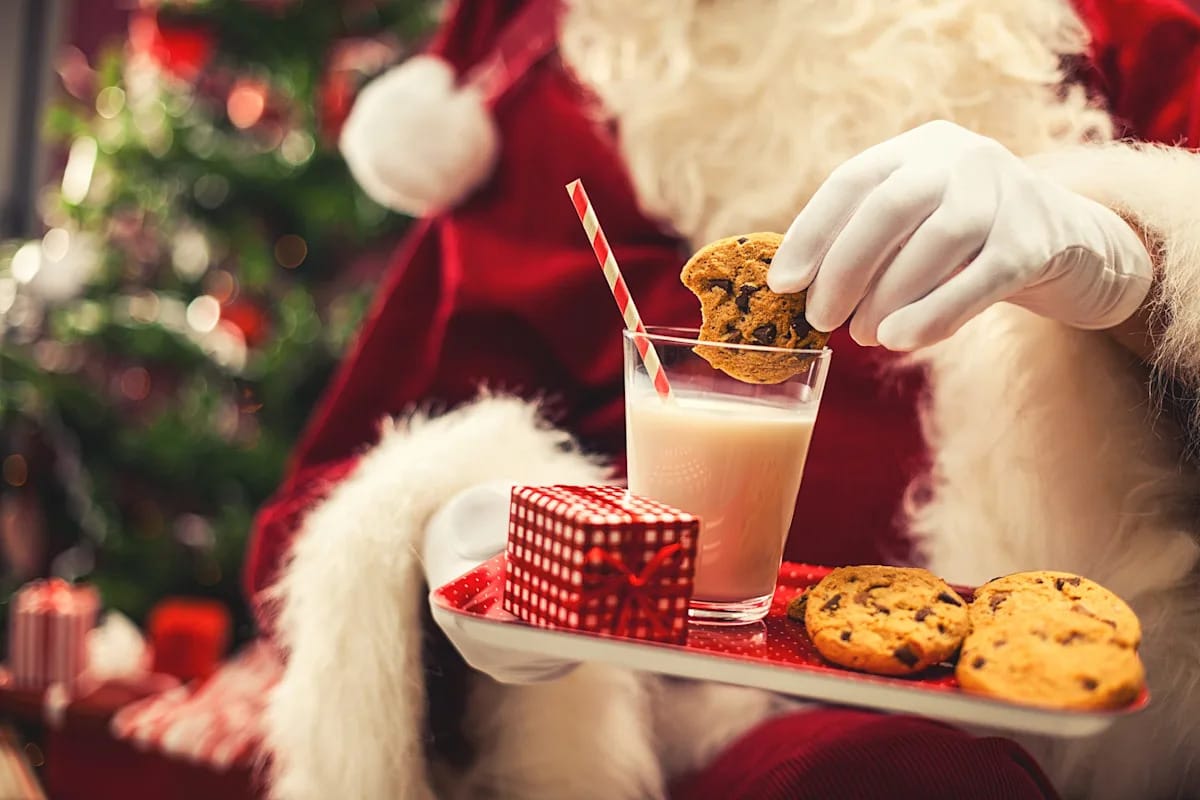
The Great Cookie Heist: How Inflation Stole Christmas
Ah, Christmas. The season of giving, joy, and existential dread for anyone managing a budget. For decades, we’ve been operating under the assumption that Santa Claus—the jolly, benevolent, perpetually unpaid CEO of the North Pole—can simply glide by on the fumes of good cheer and free labor. But let me tell you something, folks: those days are over. The man is facing a supply-side economic nightmare, and we’re all pretending it’s just ‘holiday magic.’ This isn’t just about a couple of bucks; it’s about the erosion of a tradition by the very forces that profit from it, leaving Santa high and dry in a sleigh built for 1980 prices.
The latest data point, a real lump of coal in his stocking, confirms what many of us suspected: Santa’s cookies are now costing upwards of $8.44 per batch. This isn’t some abstract financial concept; this is a direct, tangible slap in the face to a man who works one night a year, presumably without health insurance or a retirement plan. The price surge, driven largely by skyrocketing egg prices and the cost of butter, has fundamentally changed the social contract between humanity and St. Nick. It’s time to stop singing carols and start looking at the spreadsheets because we are witnessing the great Christmas economic bubble burst, and Santa’s getting shafted.
Part 1: The Golden Age of Free Labor (The Pre-Inflation Era)
Back in the good old days—let’s call it pre-2000—Santa’s job was simple. The cookies were cheap, plentiful, and frankly, probably not very good. Think about it: a child leaves out some store-brand sugar cookies and a glass of whatever milk is available, probably 2%. The cost to the consumer family? Pennies on the dollar. The psychological cost to Santa? Zero, because he felt appreciated. This was the era of maximum return on investment for the average household. A few cents for ingredients guaranteed good behavior for at least two weeks leading up to Christmas. The Grinch’s business model—stealing things—was inefficient compared to Santa’s, which was essentially a barter system based on baked goods. He was a low-maintenance deity, a non-denominational spiritual guide who only asked for a small offering in exchange for global delivery services. He operated in a market where the value of a single cookie far outweighed its monetary cost because it represented a pure, unadulterated act of giving. It was a beautiful, naive time when the price of butter wasn’t being driven by global supply chain pressures and a war in Eastern Europe.
It was a truly symbiotic relationship. The parents, eager to motivate their children, would tell them about the importance of the offering. The children, motivated by presents, would comply. Santa, presumably fueled by these low-cost carbs, would continue his work. But the problem with a system built on goodwill is that it’s highly vulnerable to market fluctuations. It assumes a stable economy where basic commodities remain affordable. We were living in a fantasy world where eggs were just eggs and not a leading indicator of inflation. This era ended, not with a bang, but with a sudden, sharp spike in the price of vanilla extract. It’s hard to believe, but for decades, Santa operated on a budget that most modern CEOs would laugh at. He was the ultimate gig worker, relying on tips from a population that increasingly views him as an inconvenience.
Part 2: The Mid-Era Shift (The Rise of Corporate Christmas)
Sometime around the early 2010s, things started to get weird. The cookies weren’t just cookies anymore. They became artisanal. They became a status symbol. Suddenly, children weren’t just leaving out whatever they had in the pantry; they were leaving out bespoke gingerbread creations with intricate frosting and organic, free-range milk from grass-fed cows. The expectation shifted from ‘simple gratitude’ to ‘culinary excellence.’ This created a massive problem for Santa’s operational efficiency. He went from consuming basic fuel to gourmet, high-octane rocket fuel. His expectations rose, but his compensation remained precisely zero dollars. The media, eager to capitalize on this trend, ran stories about how to bake the ‘perfect cookie’ for Santa, creating a psychological pressure point on parents who were already stretched thin by the season. This is where the real inflation started, not in the price of ingredients, but in the social value and effort required to participate in the tradition.
This period saw the rise of ‘holiday inflation’ as a concept. It wasn’t just the cookies; it was everything. The decorations got bigger, the presents got more expensive, and the pressure on Santa’s delivery schedule increased exponentially. The cost of a simple sugar cookie batch began to climb, slowly but surely. The supply chain became more complex, introducing vulnerabilities. The cost of fuel for the sleigh—or perhaps the cost of feeding the reindeer—started to rise. The public wasn’t seeing it as a financial crisis; they were seeing it as an opportunity for more Instagram posts. Santa, meanwhile, was silently carrying the burden of this societal shift, wondering why a single batch of cookies now required a trip to three different stores to get the specific brand of chocolate chips. The Grinch, in contrast, probably made a killing in the black market selling knock-off holiday goods.
Part 3: The Modern Crisis (The $8.44 Cookie and the Egg Scapegoat)
And now we arrive at the present day, where reality hits harder than a reindeer collision with a chimney. The $8.44 price tag on a batch of cookies, as reported by various news outlets and financial analysts who have clearly too much time on their hands, represents the breaking point. The numbers don’t lie. Inflation has driven up the cost of key ingredients like butter ($2.99 per batch, making it the most expensive ingredient) and, most critically, eggs. The egg price surge isn’t just about supply chain issues; it’s about the increased cost of feed, a global avian flu outbreak, and a complex web of logistical failures that perfectly illustrate how a seemingly simple act of giving has become financially untenable. The cookies, which were once a token offering, are now a significant household expenditure, potentially leading some families to reconsider their traditions entirely.
What does this mean for Santa? It means he’s getting paid in depreciated currency. The cost of his fuel (cookies) has increased by over $2 since 2020. This is roughly a 30% increase in four years. If Santa were a real employee, he’d be demanding a raise, a union contract, and back pay for all the years he spent operating under these exploitative conditions. But because he’s a magical figure, we expect him to simply absorb these losses. We are essentially forcing him to accept a pay cut in real-world terms. The irony here is thick: we complain about inflation in our own lives, but we expect a fictional character to be immune to it, demanding more presents while simultaneously cheapening the ‘tip’ we leave him. This highlights a deeper societal issue: our expectation of infinite, cheap labor, even from mythological figures. Are we really leaving him $8.44 worth of cookies, or are we leaving him a bill for $8.44 worth of ingredients we forced him to eat? It’s a logistical nightmare.
The core issue is that milk was the only ingredient rising slower than overall inflation, which just isn’t enough to compensate for the cost of butter and eggs. Think about that for a second. The one stable part of his diet is milk, which is arguably the least fulfilling part of the meal. He’s essentially being told to drink more water to save money while eating less of the good stuff. This isn’t just about the money, though. It’s about the message. The message is that everything, even the most cherished traditions, must bend to the will of market forces. We are normalizing the commodification of Christmas, where even Santa’s snack is analyzed for its ‘return on investment.’ This is the true meaning of Christmas in the 21st century: a relentless focus on maximizing profit and minimizing cost, even if it means sacrificing the very spirit of the season. It makes you wonder if maybe the Grinch had the right idea all along when he decided to just cut his losses and everyone else’s losses and steal everything in bulk.
Part 4: The Dystopian Future (Santa’s AI and Crypto Predictions)
So where do we go from here? The trend line suggests a future where Santa either demands a direct payment or completely reevaluates his business model. Will we see Santa’s cookies being sold as an NFT? Probably not. Will we see children leaving out a QR code for a Bitcoin tip instead of milk and cookies? Absolutely, and it’s probably already happening in Silicon Valley. The future of Christmas is likely to be a blend of high-tech efficiency and low-cost alternatives. We might see families leaving out ‘virtual cookies’ for Santa, or perhaps he’ll develop an app that allows him to accept ‘Claus Coin’ as payment for his services. The concept of a simple, homemade cookie will become a nostalgic relic, replaced by a complex financial transaction designed to circumvent supply chain issues. This isn’t just a prediction; it’s an inevitability driven by our current economic climate. The traditional Christmas, powered by simple faith and cheap ingredients, is on life support. The new Christmas will be powered by data, logistics, and high-cost, high-tech solutions.
Perhaps Santa will have to become a ‘micro-influencer,’ leveraging his global reach to secure lucrative sponsorships. Imagine Santa sponsored by a major logistics company or perhaps a cookie brand, selling his ‘official’ snack. This future is less magical and more corporate, but it’s a necessary evolution for a figure who must adapt to a changing economic landscape. The $8.44 cookie isn’t just a news item; it’s a warning shot. It tells us that nothing is sacred from the relentless pressure of inflation. It suggests that a tradition built on kindness cannot survive in a world built on quarterly earnings reports. The magic of Christmas is being replaced by the cold, hard reality of economics, and Santa Claus is just the latest victim of our collective greed. Maybe this year, we should just leave out a severance package instead of cookies and milk. He’s earned it. He really needs it.