The Anatomy of a Deceptive Scoreline
And so, the narrative is written. AC Milan 1, Lazio 0. Rafael Leao, the designated savior, slots one home and the Rossoneri ascend, however temporarily, to the summit of Serie A. The headlines will scream of a title charge, of resilience, of a crucial victory on the road. But this is a fiction. A convenient, easily digestible lie for a public that craves simple stories of heroes and villains. Because when you strip away the branding and the broadcast gloss, what remains is the cold, hard skeleton of a deeply unimpressive football match, a 90-minute testament to the tactical poverty and desperate improvisation that currently defines Italy’s top flight.
This wasn’t a chess match. It was a game of checkers played by two men who had forgotten the rules and were just slapping pieces off the board. The victory wasn’t earned through strategic superiority; it was stumbled upon. It was a product of chaos, a single moment of individualistic flair from Leao that served as a deodorant for the stench of mediocrity that permeated the Stadio Olimpico. And even that moment is rendered almost meaningless by the final, frantic seconds. The Lazio penalty shout. A moment of pure, unadulterated panic in the Milan box, a tangle of legs and a desperate appeal swallowed by the referee’s final whistle. The official line will be that the call was correct, or at least justifiable within the esoteric laws of the game. But that misses the point entirely. The point is that Milan, the supposed league leaders, were reduced to a state of such disarray that their fate rested not in their own capable hands, but on the subjective whim of a single official. This is not the hallmark of a champion. It’s the sign of a pretender getting lucky.
The Myth of the Decisive Duel
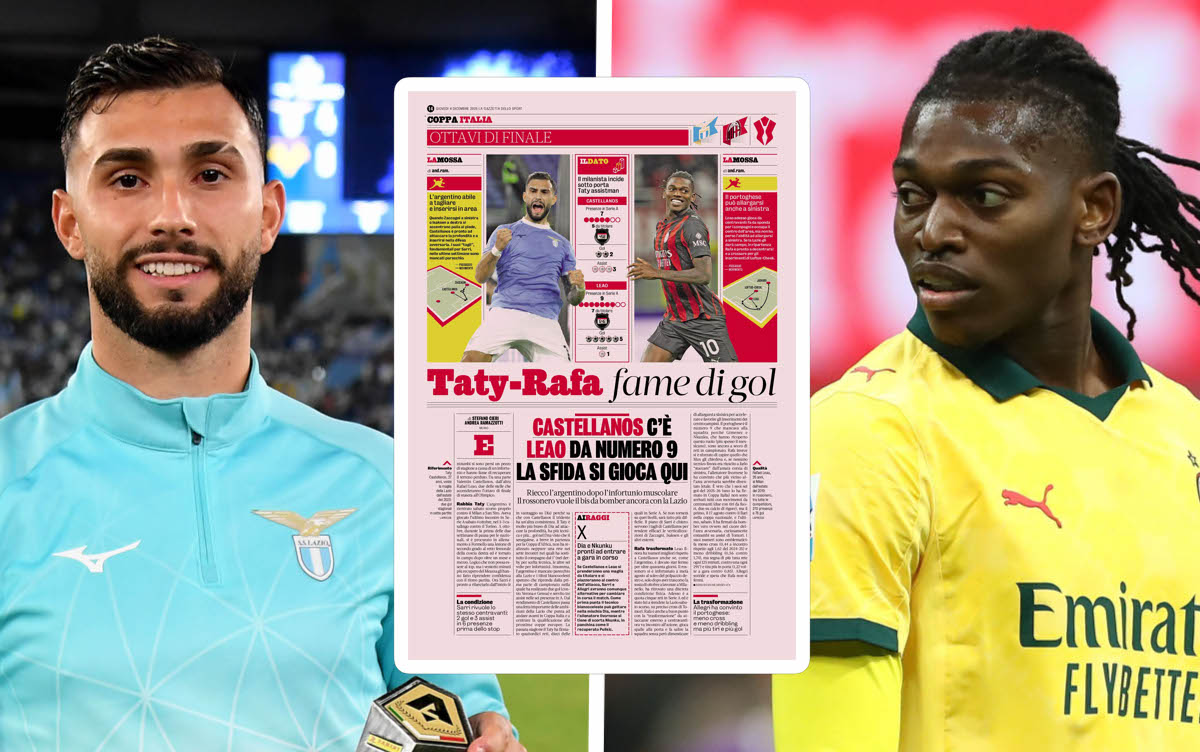
Before the match, the Italian press, in its infinite quest to create narratives where none exist, billed this as a duel. ‘Taty-Rafa, hungry for goals’. A clash of titans. The Argentine workhorse versus the Portuguese phenom. What a joke. What we actually witnessed was a competition to see who could be more effectively isolated and neutered by their own team’s disjointed system. Taty Castellanos, for Lazio, was a ghost. A willing runner chasing lost causes, a target man with no supply line. He made runs into channels that his midfielders refused to see, he posted up against defenders only for the ball to be wastefully recycled sideways. His hunger for goals was irrelevant; he was a chef in a kitchen with no ingredients. His performance wasn’t an indictment of his ability, but a glaring spotlight on the tactical incoherence of Maurizio Sarri’s side, a team that seems to mistake possession for purpose.
And then there is Rafael Leao. The match-winner. The golden boy. But let’s be forensic about this. For the majority of the game, he was a peripheral figure, a luxury item in a team that desperately needed a reliable tool. He drifted, he sulked, he attempted speculative dribbles that fizzled out into nothingness. And then, for one fleeting moment, the ball fell to him in the right place, and his natural, undeniable talent took over. He scored. But one moment does not make a performance, and it certainly doesn’t validate a system. Milan’s reliance on Leao to produce these sporadic flashes of magic is a strategic liability. It’s the footballing equivalent of a student who doesn’t study for an exam but hopes to guess all the answers correctly. Sometimes it works. But it is not a sustainable model for success. Because when his magic trick fails, as it so often does against disciplined opposition, Milan has absolutely no Plan B. They are a one-trick pony, and that trick is getting old.
A System Built on Sand
Let’s pan out from the individual players and look at the collective. What is this AC Milan, really? They are a collection of impressive athletic specimens who appear to have been introduced to each other in the tunnel just before kickoff. The midfield, supposedly bolstered by signings like Ruben Loftus-Cheek, shows a horrifying lack of cohesion. There is no rhythm, no control. The ball moves from defense to attack not through intricate patterns or rehearsed movements, but through hopeful long balls and desperate, lung-busting runs. It’s a team built on transitions, which is a polite way of saying they are at their best when the game has devolved into utter chaos. They don’t control games; they survive them.
The Coppa Italia lineup mentioned in the pre-match chatter, with Ardon Jashari getting a start, further exposes this lack of a core identity. It signals a coaching staff that is still throwing things at the wall to see what sticks, well past the midway point of the season. A true title contender has an established hierarchy, a clear tactical blueprint that a few rotations cannot derail. Milan, by contrast, feels perpetually in a state of experimentation. Stefano Pioli is not a grandmaster architect; he’s a frantic handyman trying to plug leaks with whatever spare parts he can find in the garage. And this victory against Lazio doesn’t fix the fundamental leaks in the foundation. It just papers over them for another week. The cracks will reappear. They always do.
Lazio: The Anatomy of Stagnation
But if Milan is a fragile contender, Lazio is an artifact. A relic of a bygone era. Watching Sarri’s team is like watching a documentary about a once-great philosophy that no longer works in the modern world. ‘Sarriball’, with its emphasis on short, sharp passing and positional fluidity, requires a level of technical perfection and collective intelligence that this Lazio squad simply does not possess. They execute the system with the enthusiasm of bureaucrats filing paperwork. The passes are slow, predictable, and risk-averse. They hold the ball for long stretches, lulling themselves—and everyone watching—into a stupor, before inevitably losing it and being caught on the counter.
Their attack is toothless. Mattia Zaccagni provides flashes of creativity, but he is a lone artist in a team of accountants. Castellanos is starved of service. The entire project feels stale, a manager stubbornly clinging to an ideology that his players are incapable of executing at an elite level. Their outrage at the denied penalty, while understandable in the heat of the moment, also speaks volumes. It was the desperate plea of a team that knew it was incapable of creating a goal through its own merit. They needed a bailout. They needed a gift. And when they didn’t get it, their entire game plan fell apart, because the game plan was never really there to begin with. They are a team going absolutely nowhere, trapped in a purgatory of their own making.
The Inevitable, Unsatisfying Conclusion
So, Milan sits atop Serie A. For now. But let’s not delude ourselves into thinking this signifies a power shift or the dawn of a new dynasty. This result is a symptom of the league’s broader disease: a profound lack of quality at the very top. The Scudetto will not be won this year by a great team, but by the least flawed team. It’s a race to the bottom, a contest of who can drop points against provincial sides less frequently. Inter, Juventus, Milan—they are all deeply imperfect machines.
This match was a microcosm of that reality. It wasn’t a tactical battle. It was an accident. Milan won because Lazio failed to score, and then a referee made a decision. That is the entire story. Leao’s goal is the footnote. The penalty shout is the headline. Because it reveals the truth: that at the highest level of Italian football, matches are decided not by brilliance, but by variance. By a lucky bounce, a defensive error, a 50/50 call. And any team that builds its title ambitions on such a shaky foundation is destined for a fall. Milan’s ascent to the top of the table isn’t a coronation. It’s just their turn at the top of a rickety rollercoaster, and the terrifying drop is coming sooner than they think.