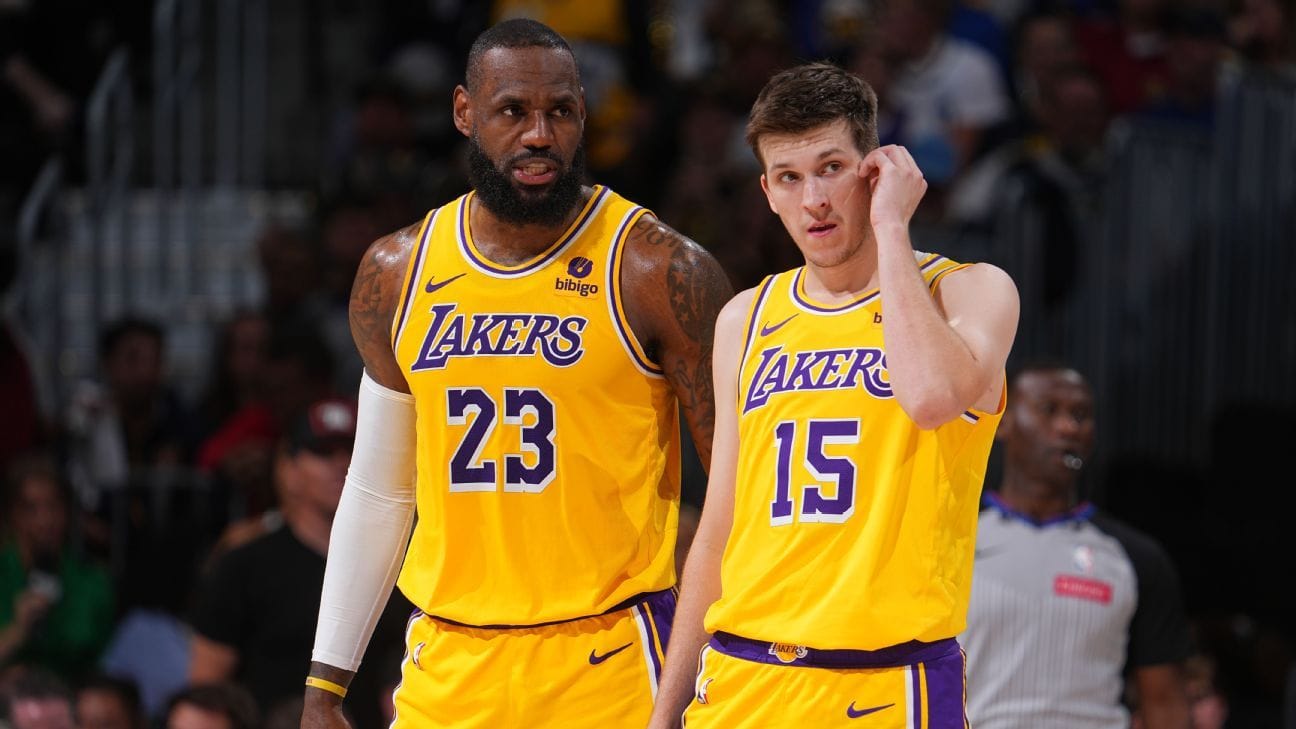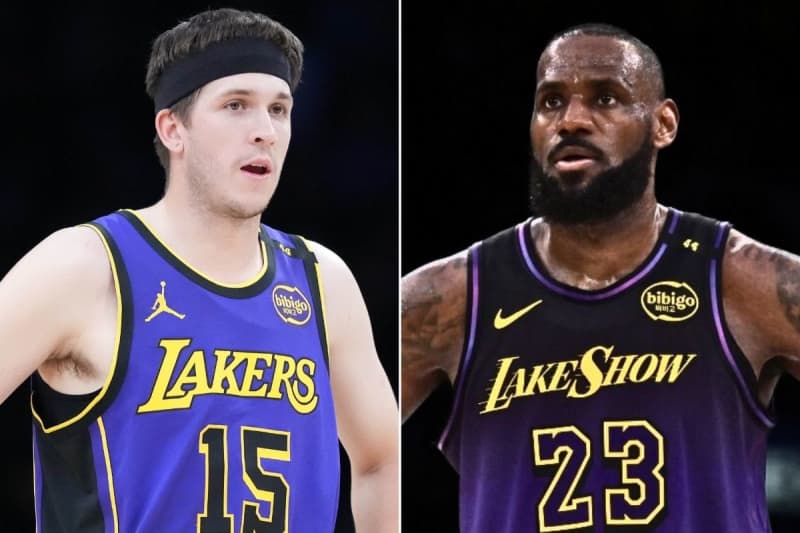
LOS ANGELES – The roar of the Staples Center crowd had barely faded, the lingering scent of victory still hung in the air after the Los Angeles Lakers’ commanding 141-116 triumph over the Atlanta Hawks on Tuesday night. It should have been a moment of collective relief and positive momentum for a team often battling external narratives and internal pressures. Yet, as the final buzzer echoed, another, more intricate battle was just beginning to unfold off-court, centering on the unequivocal voice of the team’s undisputed leader, LeBron James.
In the quiet intensity of the post-game media scrum, James chose not to dwell solely on the basketball heroics. Instead, he made a calculated and significant move: publicly separating himself from the recent, highly speculative remarks made by his long-time friend and influential agent, Rich Paul of Klutch Sports. Paul’s comments, which included hypothesizing about sending promising young guard Austin Reaves to the Memphis Grizzlies in a hypothetical trade scenario on a recent podcast, had clearly stirred an unwanted pot, injecting fresh tension into an already fragile Lakers environment.
The Agent’s Provocation: Speculation and Scrutiny
Rich Paul is not just an agent; he is an institution in the modern NBA landscape. As the founder of Klutch Sports Group, he represents a star-studded roster of athletes, with LeBron James as his marquee client and close confidant. Their relationship extends beyond professional representation, intertwining business, friendship, and a shared journey through the league’s highest echelons. This deep connection, while often a source of strength, also means that Paul’s public pronouncements carry an exceptional weight, often interpreted as reflecting the inner workings or even the desires of James himself.
It was on a recent podcast appearance that Paul ventured into the speculative realm, discussing “fake trades” – hypothetical scenarios that, while common fodder for sports talk radio and fan forums, rarely come from an agent of his stature. His specific suggestion, floating the idea of Austin Reaves being traded to the Grizzlies, was not merely abstract. It targeted a specific, valuable player on his client’s own team, and it did so in a public forum, turning an otherwise innocuous discussion into a potential source of internal discord.
The practice of “dreaming up fake trades” can be a ubiquitous part of sports conversation, a harmless pastime for enthusiasts dissecting team rosters and future prospects. However, when such ideas emanate from an agent deeply entwined with the team’s superstar, they transition from harmless speculation to potentially disruptive declarations. For a team like the Lakers, already navigating a challenging season with high expectations and frequent media scrutiny, such comments can be particularly unhelpful, adding to an “increasingly gloomy reality” rather than alleviating it.
The Weight of Words: Why Paul’s Comments Matter
An agent’s role is multifaceted: to secure contracts, manage endorsements, and protect their client’s interests. This often involves navigating complex team dynamics and maintaining positive relationships with front office personnel. Publicly discussing the trade of one’s client’s teammate, particularly without any official sanction or necessity, can be seen as undermining team cohesion and potentially devaluing a player. For Austin Reaves, a young talent who has steadily grown into a vital contributor for the Lakers, being named in such a hypothetical trade by a figure as influential as Rich Paul could create uncertainty and anxiety.
The timing of these remarks also adds to their contentious nature. With the NBA trade deadline often serving as a crucible for teams hoping to either bolster their roster or retool for the future, any suggestion of player movement from within a star’s inner circle can be perceived as an implicit push or a signal of dissatisfaction. In the high-stakes world of professional basketball, where narratives can shift rapidly and whispers can turn into seismic events, the line between casual commentary and impactful statement is often blurred, especially when uttered by someone with Paul’s unique access and influence.
LeBron’s Public Disavowal: Clearing the Air
It was against this backdrop that LeBron James stepped forward. His post-game comments were not merely a casual dismissal; they were a deliberate, calculated act of separation. “I’m not going to get into a Rich Paul conversation,” James might as well have said, but his message was far more direct and emphatic. By explicitly stating he was “separating himself from the opinion of his agent,” James conveyed a powerful message: Paul’s hypothetical trade ideas did not reflect his own views, nor, by extension, the perceived stance of the Lakers’ most important player.
This public disavowal is notable for several reasons. For decades, LeBron James and Rich Paul have presented a unified front, a testament to their enduring partnership. Instances of James publicly contradicting Paul are exceedingly rare, making this particular moment all the more significant. It signals either a genuine disagreement on a sensitive issue or a strategic effort by James to mitigate the damage caused by Paul’s remarks, demonstrating loyalty to a teammate and commitment to the current roster amidst mounting external pressures.
The Delicate Balance of Power and Influence
The dynamics within a professional sports organization are always complex, but few are as intricate as the relationship between a superstar player, their influential agent, and the team’s front office. LeBron James, arguably the most powerful player in the NBA, wields significant influence over the Lakers’ strategic decisions, from coaching hires to roster construction. Rich Paul, through Klutch Sports, serves as a crucial conduit for that influence, often acting as a spokesperson or negotiator on James’ behalf.
However, this influence also carries the burden of responsibility. When an agent’s public musings veer into territory that could destabilize the team or upset its players, it can create friction between the agent, the player, and the organization. James’ decision to publicly clarify his position suggests an awareness of this delicate balance, perhaps indicating a desire to protect team chemistry and avoid further speculation that could derail the Lakers’ aspirations.
Lakers’ Internal Discontent: Stirring the Wrong Pot
The repercussions of Paul’s comments extend beyond mere media chatter. Reports have emerged indicating that the Los Angeles Lakers organization is “unhappy with LeBron James’ Inner Circle over Demand to Trade Star.” While the term “inner circle” is broad, the context of Paul’s specific comments about Austin Reaves points directly to him as the primary source of this discontent. The implication is clear: Paul’s public theorizing was perceived not as idle talk, but as an implicit “demand to trade star,” creating a significant rift within the franchise.
Such a report underscores the gravity of Paul’s podcast appearance. It suggests that the front office viewed these comments as more than just an agent idly “dreaming up fake Lakers trades.” Instead, they were interpreted as an attempt to exert pressure or signal a desire for a roster change, potentially coming from a source too close to the team’s central figure. This kind of internal friction can be far more damaging than external criticism, eroding trust and creating an unstable environment for players and management alike.
The Impact on Austin Reaves: A Player in Limbo?
Austin Reaves has been a revelation for the Lakers since joining them. His emergence as a reliable perimeter shooter, capable secondary ball-handler, and tenacious defender has made him an invaluable asset. He embodies the kind of young, cost-controlled talent that every contending team covets. To have his name publicly dangled in trade scenarios, especially by a figure so closely associated with the team’s superstar, puts him in an unenviable position.
For any player, hearing their name in trade rumors can be unsettling, affecting focus and morale. When those rumors originate from the agent of the team’s most influential player, it can be particularly demoralizing, potentially signaling a lack of confidence or a desire for change from within the team’s power structure. James’ public separation from Paul’s comments, therefore, serves a dual purpose: not only to clarify his own position but also to potentially offer a vote of confidence to Reaves and reassure him of his standing within the Lakers organization.
The Increasingly Gloomy Reality: A Season of High Stakes
The phrase “increasingly gloomy reality” perfectly encapsulates the Lakers’ predicament this season. Despite glimpses of brilliance and the enduring greatness of LeBron James, the team has struggled to find consistent chemistry and ascend to the top tier of championship contenders. Injuries, inconsistent performances, and the relentless pressure of playing in Los Angeles have all contributed to an atmosphere of heightened scrutiny and frequent speculation about the team’s future.
In this context, Rich Paul’s “fake trades” were not merely unhelpful; they were counterproductive. Instead of fostering unity or projecting stability, they introduced another layer of uncertainty, another narrative for the team to combat. For a franchise that often feels like it’s perpetually under a microscope, such internal rumblings only serve to amplify the existing challenges, diverting attention from on-court performance to off-court drama.
The Lakers’ management, led by Rob Pelinka, faces immense pressure to build a championship roster around James in the twilight of his illustrious career. Navigating the influence of James’ inner circle, while simultaneously maintaining team cohesion and managing player assets like Austin Reaves, requires a delicate touch. Public trade demands, whether explicit or implied through an agent’s musings, complicate this intricate dance significantly, potentially straining relationships crucial for long-term success.
Conclusion: The Unspoken Language of Power
LeBron James’ public clarification following the Hawks game was more than just a soundbite; it was a carefully calibrated response to a situation that threatened to further destabilize his team. It underscored the immense power wielded by agents like Rich Paul and the even greater influence of superstars like James. Their words, whether spoken directly or through their representatives, resonate far beyond the confines of a podcast studio, shaping perceptions, influencing morale, and impacting the intricate machinery of an NBA franchise.
In professional sports, the court is not the only arena where battles are fought. The boardroom, the locker room, and even the digital airwaves become battlegrounds where narratives are crafted, loyalties are tested, and the delicate balance of power is constantly negotiated. As the Lakers continue their quest for glory, they must not only contend with opponents on the hardwood but also navigate the complex, often unspoken, language of influence that defines the modern sports landscape. “Every word carries weight, especially when it comes from those closest to the throne,” a seasoned NBA observer might reflect, “and sometimes, the most important plays happen off the court, long after the final whistle.”