The Era of Expected Failure: When Football Becomes a Spreadsheet
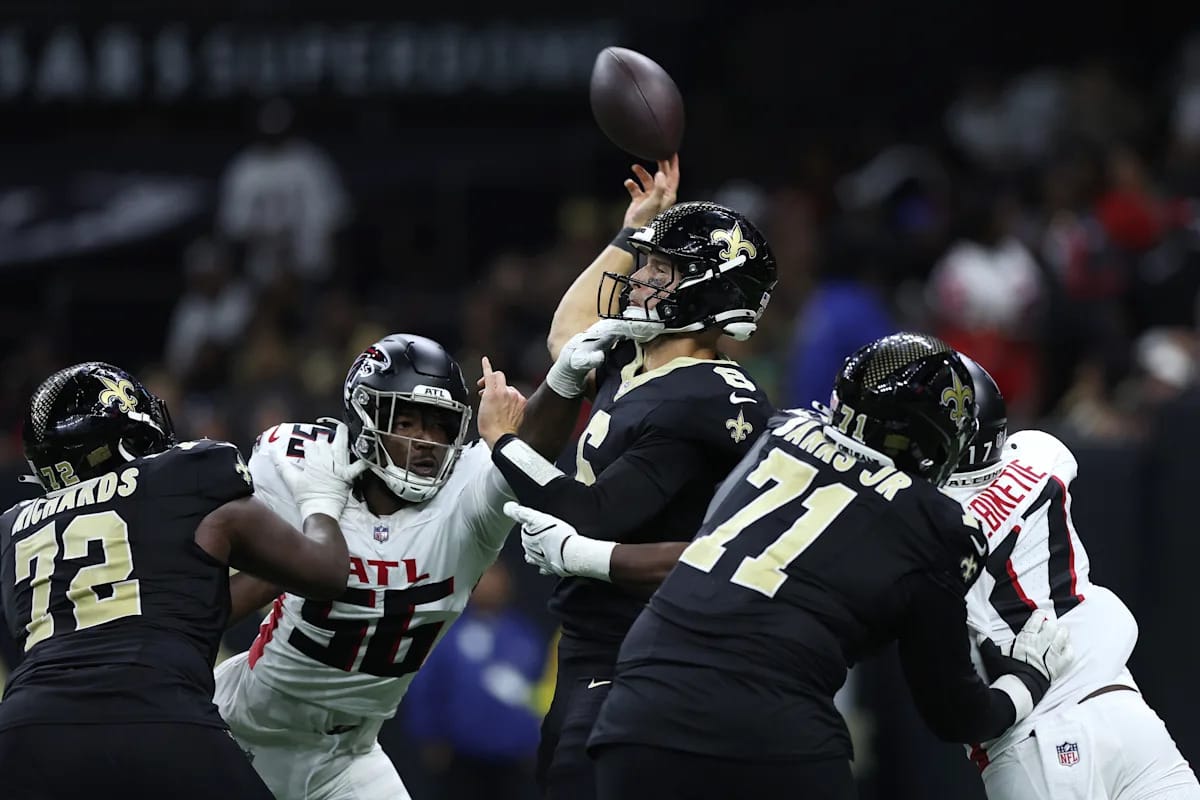
And here we stand, at the bitter, anticlimactic close of another NFL season, watching the New Orleans Saints (6-10) and the Atlanta Falcons (6-10) prepare to duke it out, not for glory, but for the right to potentially limp into the postseason because the rest of the NFC South decided to collectively trip over their own shoelaces; I mean, they call this a divisional race, but it feels more like two exhausted oxen dragging a broken plow through mud, occasionally bumping into a barely defeated Carolina Panthers or a Buccaneers squad whose recent victory only serves as a temporary reprieve before their inevitable statistical regression.
It’s heartbreaking, really. Total system failure.
The Glory Days: When Rivalry Meant Blood, Not Buffer Rates
Because if you cast your mind back—before every coaching decision was dictated by a probability engine running on a server farm in Silicon Valley, before every snap was analyzed through seven different proprietary software suites designed to minimize ‘risk’—this game meant something visceral. It was about regional pride, about the sheer, unbridled hatred that couldn’t be quantified in a ‘win probability chart’ that constantly flashed red whenever a human player decided to trust his gut instead of the tablet shoved in his face on the sidelines, an era where the grit of players like Morten Andersen defined the rivalry, rather than the salary cap space calculated down to the last penny by some intern fresh out of an Ivy League data science program.
They didn’t need data then.
But now, the very concept of ‘Key Ingredients to Victory’—as the headlines so blandly put it—is nothing more than corporate-speak for: ‘Here are the three statistical categories our software says we absolutely must optimize to beat their software.’ The mystique is gone; replaced by a sterile, sanitized focus on ‘efficiency’ and ‘optimization,’ which, when applied to two fundamentally flawed 6-10 teams, only results in the most efficient form of mediocrity ever observed in professional sports, forcing fans to engage in complex mathematical calculations just to figure out what combination of outcomes could possibly result in a meaningless playoff berth.
It’s just noise, folks.
The Present Quagmire: Algorithms Running Amok in Flowery Branch
And the current reality, particularly for the Falcons, is a glaring indictment of this data-driven obsession, where a team with undeniable physical talent consistently underperforms because the systems put in place—the highly paid coordinators obsessed with micro-managing every route, the general managers valuing ‘positional value’ over raw talent, and the incessant reliance on third-party analytics firms—have completely stripped the necessary human element out of the competitive equation. Furthermore, the news coming out of Flowery Branch, perpetually focusing on the transactional, the scheduled, and the highly controlled flow of information, is the perfect mirror for a league that prefers scripted narratives and predictable outcomes over the unpredictable chaos that makes football truly magnetic, leading to the utter decay of the NFC South into a perpetual punchline, proving definitively that if you rely entirely on machines to make your emotional decisions, you will inevitably end up depressed and confused.
It’s a broken system.
Because look at the Saints’ recent ‘streak’: winning four straight games, yes, but against whom? Are those wins based on genuine, sustainable football prowess, or simply favorable statistical matchups that the predictive models identified six weeks prior, allowing the organization to pivot slightly and gain marginal advantages over equally confused opponents, thus validating the flawed internal metrics the general manager uses to justify his exorbitant salary while simultaneously failing to build a genuinely formidable, threat-level team capable of competing in a non-laughable division? The narrative is always manufactured: four straight wins is supposed to sound impressive, but when those wins are merely the statistical product of a weak scheduling matrix and timely opponent injuries, the celebration feels hollow and artificial, like listening to synthesized music instead of a live orchestra.
It’s just simulation, not life.
The Tech Skeptic’s Timeline: The Bleak Future of the NFC South
But the problem isn’t just the current 6-10 records; the real danger lies in the institutional adoption of this ‘Tech First’ mindset, which promises optimization but delivers conformity, ensuring that both the Falcons and the Saints will continue to exist in a cyclical hell of eight-win seasons, never truly terrible enough to rebuild completely, yet never genuinely threatening enough to contend for anything meaningful beyond a Wild Card slot they will immediately squander in a painful, low-scoring defeat, all because the front offices are too terrified of stepping outside the pre-approved quantitative parameters set by the data crunchers who tell them exactly what percentage risk they are taking by drafting a ‘non-traditional’ player or hiring a coach whose philosophy hasn’t been A/B tested against the league average, thereby guaranteeing future stagnation.
We are stuck in the loop.
And I predict that by 2030, this rivalry won’t even be played by humans, but by advanced, sensor-laden drones piloted remotely by the highest-paid data scientists in the league, who will be able to instantaneously calculate ball trajectory, momentum vectors, and opponent fatigue levels, producing a game that is technically perfect, utterly efficient, and completely devoid of any spirit, passion, or the glorious, human tendency to screw things up spectacularly when the pressure is highest, which is, ironically, the one thing we actually pay to see—the unpredictable, magnificent failure of human endeavor when faced with overwhelming odds—something the algorithms are desperately trying to erase from the sport, reducing it all to a predictable equation.
The thrill is long gone.
Because when you read that article about ‘What does Saints-Falcons mean for the NFC South in Week 18,’ the answer is sickeningly simple: it means nothing, absolutely nothing, except the final confirmation that modern professional football, particularly in this division, has evolved into a sophisticated, highly digitized form of performance art designed solely to fleece ticket holders and TV networks, providing the illusion of meaningful competition while the actual outcome is mathematically bounded and increasingly boring, driven by metrics that prioritize long-term salary cap health and brand management over the simple, exhilarating act of winning football games with sheer, terrifying force. The league is obsessed with the ‘picture,’ the visual display of the playoff tree, but ignores the mold growing on the fruit beneath the glossy surface, preferring the data visualization to the actual visceral reality of mediocrity.
We deserve better than this calculated garbage.
And the way they structure the game now, focusing on the ‘season finale’ aspect as if this were the culmination of some grand, heroic struggle, conveniently ignores the painful fact that the only reason either of these teams is still relevant in Week 18 is because of the monumental collapse of every other contender in the division, resulting in a scenario where two functionally incomplete, statistically mediocre rosters are artificially elevated to high-stakes relevance, validating the flawed processes that got them here in the first place, ensuring that the vicious cycle of paying lip service to analytics while achieving sub-par results will continue unabated into the next decade, much to the chagrin of any fan who remembers when the game was played on the turf, not in the cloud.
Stop trusting the screens.
But hey, the systems are happy, the owners are counting their money based on projected viewership models, and the data scientists are busy feeding more flawed metrics into the predictive maintenance software, pretending that they can reverse-engineer passion and drive from complex regression analysis, ignoring the basic truth that victory is often messy, emotional, and illogical, things that their pristine, automated world views cannot tolerate, which is why we keep getting these sterile, predictable, six-win seasons that promise the world and deliver only the tedious recalculation of draft picks and cap casualties.
Just watch the game and weep.
And the very idea that Tampa Bay’s squeaker over Carolina—a game decided by two points in a defensive slugfest that looked like both teams were actively trying to avoid the playoffs—somehow sets the ‘stage’ for this showdown is truly the icing on this stale, algorithmic cake, confirming that the entire NFC South is less a football division and more a living case study in statistical underachievement, proving definitively that if you give highly intelligent people too much data and too little accountability, they will inevitably engineer a beautiful, complex failure.
It’s a stunning display of calculated incompetence.
Because even if one of them wins and secures that dubious playoff spot, what then? Do we believe that the same flawed system, the same predictive modeling that guided them to 7-10 or 8-9, will suddenly undergo a spiritual transformation in the postseason and deliver the necessary human grit and emotional resilience required to upset a genuinely dominant opponent like San Francisco or Philadelphia? No, of course not. They will be exposed, surgically disassembled by a team that remembers how to play football without consulting a flow chart, confirming the Tech Skeptic’s long-held belief that relying on automation and data supremacy in a field governed by human error and passion is a recipe for expensive, highly predictable defeat. The victory in Week 18 is a poisoned chalice, forcing the winner to suffer one more statistically inevitable, televised humiliation.
The data points always lead to doom.