
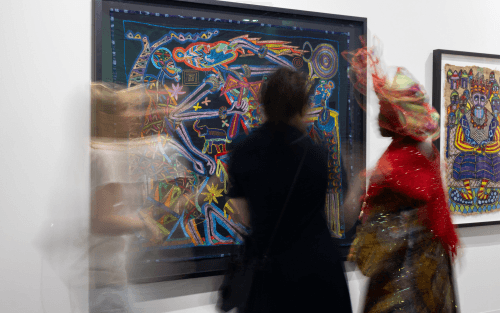
THE OFFICIAL LIE: Strong Sales, Engaged Collectors, and a Digital Renaissance
“Superfecta” of Digital Art Buzz at Art Basel Miami Beach
They tell you it’s a success. The headlines scream about “strong sales and digital art buzz.” We hear about a VIP preview where collectors were “engaged” and making “seven-figure blue-chip acquisitions.” The official narrative from the media outlets (who, let’s face it, are often just PR extensions for the billionaires funding these events) paints a picture of vibrant, healthy commerce, where an art market that has faced years of scrutiny and occasional drops has returned stronger than ever, proving its resilience and validating the astronomical prices. This narrative is designed to reassure the participants—the galleries, the collectors, the investors—that everything is fine, that this is just culture and capitalism working hand-in-hand, and that the value of these assets will continue to rise indefinitely. They want you to believe that the art market is a safe haven for wealth, a place where taste and investment converge seamlessly in a beautiful, high-gloss environment that celebrates creativity and cultural contribution. They call it a “superfecta” of sales; a nod to high-stakes gambling that tells you exactly what kind of game this really is.
They want you to look at the pretty pictures. They want you to focus on the celebrities and the parties and the sheer spectacle of it all, because if you look too closely at the numbers—if you actually calculate the amount of money changing hands in a few days compared to the global economic precarity of everyone else—you realize what a grotesque, unsustainable farce this truly is. This isn’t a celebration of art; it’s a desperate, last-ditch attempt by the super-rich to prop up a fundamentally broken system (a system, by the way, that they themselves broke) before it finally gives way under the weight of its own internal contradictions. The “strong sales” aren’t a sign of confidence; they’re a symptom of anxiety, a panicked reshuffling of assets by a terrified financial class trying to find a place to park their money where the government can’t trace it.
THE TRUTH: This Is a Panic Room for Capital Flight and Imminent Collapse
Art Basel as a High-Stakes Financial Asylum
Forget the aesthetics. Forget the discussion about whether a banana taped to a wall counts as art (it doesn’t, by the way). The truth, and the thing that should keep you up at night, is that Art Basel and similar events aren’t cultural festivals; they are high-security financial clearinghouses for the global elite. The input data, mentioning “seven-figure acquisitions,” should be read not as a success story for artists, but as a red flag for economists. Why? Because the art market offers one of the few remaining unregulated, anonymous, and highly liquid ways to transfer massive amounts of wealth across international borders without triggering any alarms. When a collector buys a piece for $10 million, they are not necessarily buying it because they love the color or the brush strokes. They are buying it because a $10 million piece of art is a physical, mobile asset that can be transported, stored in a freeport (which is essentially a tax-free zone where assets exist outside of legal jurisdiction), and traded for another $10 million asset in a completely different country without ever hitting a traditional bank ledger. This is the ultimate “hot money” mechanism, far superior to real estate or stocks, because its value is almost entirely subjective and speculative. The panic alarmist sees this for what it truly is: a desperate attempt to move assets from a collapsing financial system into something less regulated, a final grab before the global economy resets.
The Digital Art Buzz: NFTs and the New Bubble
The input data highlights “digital art buzz.” This is the most alarming part of all. It’s not just a trend; it’s the evolution of the scam into a new, faster, more volatile form. The rise of digital art and NFTs (non-fungible tokens) has essentially taken the already opaque and unregulated art market and layered on top of it the most speculative, high-risk elements of the cryptocurrency world. We’re talking about transactions in a completely decentralized, unregulated ledger (a blockchain) where the value is based purely on hype and the manufactured scarcity of a digital file that can be copied infinitely with a right-click save. The “buzz” isn’t about artistic merit; it’s about algorithmic speculation. It’s about creating a new class of assets that wealthy individuals can trade with each other in a frenzy of volatility, generating new wealth and—here’s the kicker—evading traditional capital gains taxes by claiming losses on these highly risky assets. The panic in Miami isn’t just about traditional art; it’s about the fear that this new digital market, which has ballooned to unfathomable heights, will pop even faster than the traditional one. (and it will, mark my words).
The Art Market as a Tax Dodge and Social Signaling
Let’s talk about the logistics of the panic. The “strong sales” also serve another, more mundane purpose for the high-net-worth individual: tax avoidance. When a billionaire buys a piece for $20 million, they often don’t keep it forever. Instead, they donate it to a museum (often a museum they themselves founded or control) and claim a massive tax deduction for the full value of the artwork. The government essentially subsidizes their purchase, and they get to look like a generous philanthropist while reducing their tax burden dramatically. This is a brilliant, and absolutely evil, financial maneuver that allows them to maintain their wealth and status in society. The “engaged group of collectors” mentioned in the input data aren’t really engaged in art appreciation; they are engaged in maximizing their financial efficiency. (It’s all just spreadsheets, really, dressed up in pretty colors.) Art Basel becomes a massive social signal where you demonstrate your worth by participating in the game, a game where the cost of entry is astronomical but the potential for profit and tax avoidance is even higher. This creates a feedback loop where prices spiral upward not because of demand from genuine buyers, but because of demand from financial engineers looking for a new place to park money. It is a closed loop of self-congratulation that has absolutely zero connection to the real economy. It’s a house of cards, built on nothing but fear and greed.
The Imminent Collapse: Why You Should Be Terrified
The panic alarmist perspective predicts one thing: this cannot last. The input data talks about “strong sales” and “steady mid-range activity,” but this is just the sound of the engine running on fumes. The art market historically operates on a cycle of boom and bust, and right now, we are at the very peak of the boom. The combination of easy money policies over the last decade (low interest rates, quantitative easing) created a massive liquidity surplus that needed somewhere to go. Art became the new real estate for the super-rich. Now, with inflation rising, interest rates increasing, and a global economic slowdown looming (in part caused by the very people at Art Basel), that liquidity is drying up. The “engaged collectors” aren’t buying because they’re confident; they’re buying because they are desperate to liquidate other assets and hide their money in something less regulated before the inevitable reckoning. When the bubble finally pops—and it will pop, mark my words—the prices of these artworks will plummet faster than a stone dropped from a skyscraper. The “seven-figure blue-chip acquisitions” will suddenly become worthless pieces of canvas and paint, a stark reminder of the financial insanity that defines our age. We are witnessing the last, frantic gasp of a dying financial system, and Art Basel is simply where they go to celebrate before the final plunge. The superfecta is just a way of saying: place your bets, because the whole thing is about to go bust.
Photo by Rollstein on Pixabay.