
The Endless Loop of a Hollywood Tragedy: Andy Dick and the System That Refuses to Learn
And so we go again. Because if you were genuinely shocked by the latest news out of Hollywood regarding Andy Dick, you haven’t been paying attention to the script. The script, of course, isn’t a new high-budget drama or a groundbreaking comedy; it’s the same tired, predictable loop of celebrity self-destruction that Tinseltown has been perfecting for decades, a cycle where public failure becomes just another form of currency, traded freely in exchange for a temporary spotlight.
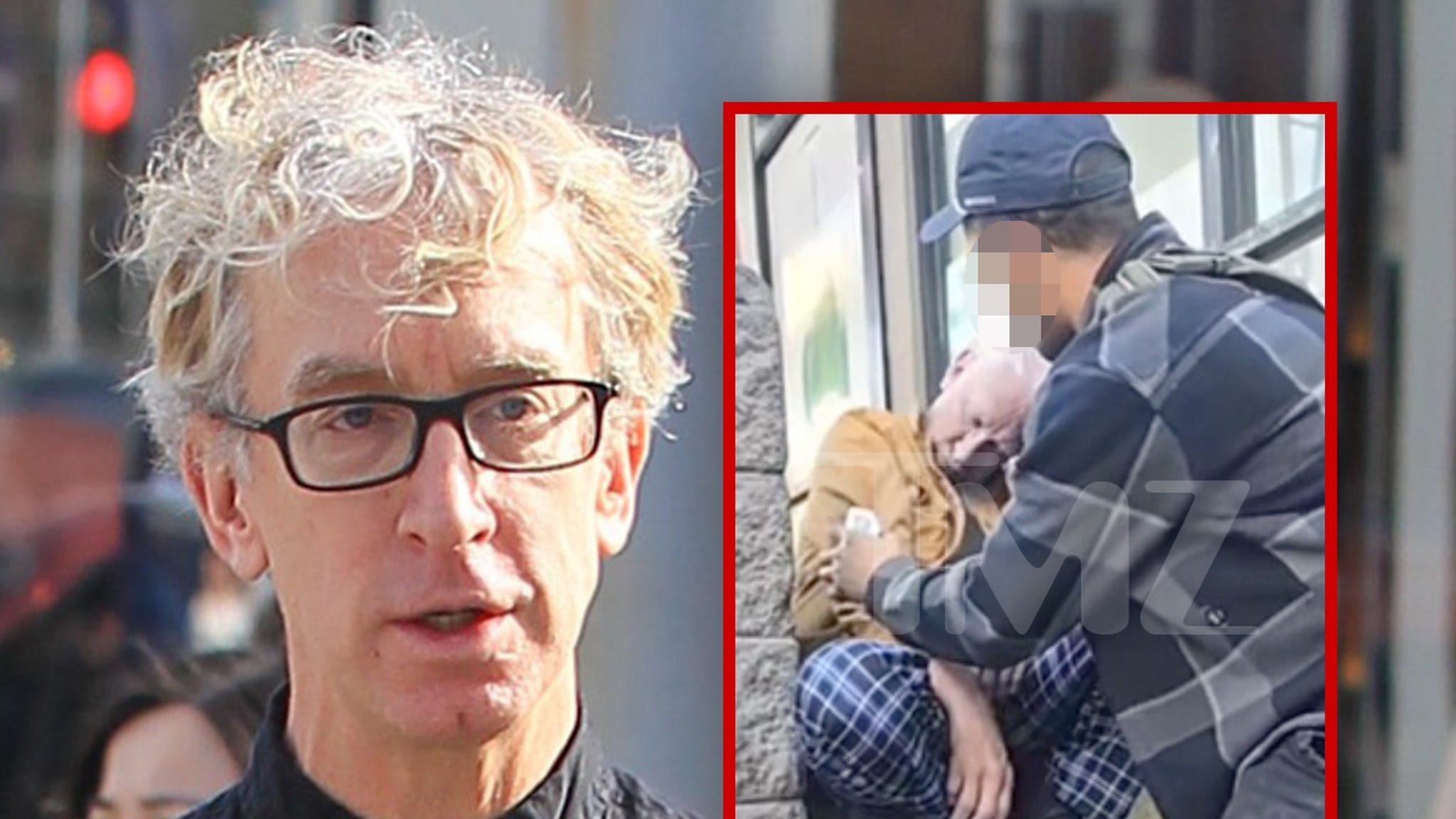
It’s a tale as old as time, a story written in bold letters across the sidewalks of Hollywood where dreams go to die in plain sight. We just witnessed another scene change in the long-running tragicomedy of Andy Dick, a man whose career arc has less to do with comedy and more to do with documenting a slow-motion catastrophe. The reports are sterile and to the point: Andy Dick, 58, found slumped over on a Hollywood street corner, suffering an apparent overdose. The LAPD responded, and he was quickly transported to a local hospital. And just like that, the news cycle spins, giving us exactly what we expected, exactly what we’ve seen before, and exactly what we’ll probably see again next year.
The Cynical Investigation of a Non-Surprise
But let’s not pretend this is shocking information. Because the reality is, this isn’t news; it’s confirmation. It’s confirmation that the system designed to supposedly protect its performers—the very system that profits from their unique talents—is fundamentally broken, rotten to the core, and utterly incapable of handling the human cost of its own demands. Andy Dick is a classic case study of a specific kind of celebrity casualty: the court jester who, when the laughter stops, finds himself completely discarded and left to spiral in public view. The media, the public, and the very industry that gave him fame have all normalized this descent to the point where we barely register it as a tragedy anymore. We just sigh and update our mental notes on the inevitable timeline of celebrity demise.
And let’s be blunt about the hypocrisy here: the industry loves a comeback story, but only after a very public, very painful fall. But in reality, they just keep the cycle moving, encouraging the public spectacle because it sells clicks and drives ratings for the very news reports that condemn the behavior. We are all complicit in this. Because we’re watching, aren’t we? We’re reading this right now. We demand the drama, and Hollywood delivers, with its performers as disposable pawns in a high-stakes game of public morality.
The History of a Public Downfall
But to understand the present, we must look at the past, because this isn’t Dick’s first rodeo. Not by a long shot. His history of arrests and public incidents stretches back decades, creating a timeline that reads like a warning sign for anyone who chooses to enter the Hollywood machine unprepared for its darker aspects. His troubles began long ago, escalating from minor public intoxication arrests to more serious charges of sexual battery and assault. He’s been in and out of rehab more times than most people change apartments. And yet, every time, he returns to the spotlight, often with a self-aware, albeit chaotic, attempt at humor. But even as he tried to laugh off his problems, a serious pattern emerged: a pattern that clearly shows a man struggling desperately, openly, and repeatedly with severe mental health issues and addiction.
Because the industry doesn’t just enable this; it profits from it. It cultivates the image of the “edgy” comedian, the “troubled artist,” and the “unpredictable genius.” But when the unpredictability becomes genuinely dangerous, when the genius fades, and the artist collapses on a street corner, the system turns its back. The very people who laughed at his jokes for years, who hired him for his specific brand of chaotic energy, are now the first ones to express “shock and disappointment.” But they knew exactly what they were getting into. The entire structure of Hollywood, from talent agencies to production companies, operates on a principle of risk assessment, and in many cases, they calculate that the potential for a newsworthy relapse, a new angle for a reality show, or a new headline for a tabloid is worth the human cost.
The Rehab-to-Relapse Cycle and the Cynical Takeaway
And what exactly happens next in the Andy Dick playbook? We can predict the steps with alarming accuracy because we’ve seen this play out with countless other celebrities, from Lindsay Lohan to Charlie Sheen and beyond. First, there’s the immediate medical intervention, followed by a brief stint in rehab where a team of publicists attempts to manage the narrative. Then comes the carefully staged public apology, typically on a late-night talk show or through a carefully curated interview in a sympathetic publication. He’ll express remorse, talk about finding a new path, and maybe even mention a new project in development. But ultimately, the cycle repeats. The statistics on recovery for individuals in high-pressure environments like entertainment are notoriously grim, and the cycle of relapse and recovery often becomes a perpetual loop. It’s a revolving door, and Hollywood is happy to keep turning the knob because it keeps the content machine fed.
But what if we looked at this not as a personal failure, but as a systemic one? Because the Cynical Investigator asks a different question: Why does the system keep producing this result? Why does it seem so much easier for Hollywood to let someone crash and burn publicly than it is to provide a stable, long-term support system that truly prioritizes well-being over performance? The answer is simple and ugly: because the current system is profitable. The drama sells. The recovery story, followed by the relapse story, followed by the recovery story—it all generates revenue. And until that economic model changes, until the public stops demanding the tragedy, the cycle will continue indefinitely. We are essentially watching a high-budget snuff film played out in real-time, where the star is forced to perform their own destruction for our entertainment.
Future Predictions and the Inevitable Conclusion
And so, where does Andy Dick go from here? The cynical prediction is bleak. He will likely resurface soon, perhaps in a smaller role, perhaps in a reality show based on his struggles, perhaps in a podcast where he details his journey to sobriety. But given the history, and given the pressures of a system that demands constant performance and offers little genuine support, the likelihood of a long-term, stable recovery is minimal. The very elements that contributed to his downfall—the constant pressure, the easy availability of substances in certain social circles, and the public’s fascination with his chaotic persona—will remain in place. He is a product of his environment, and Hollywood has yet to show that it is truly capable of changing that environment.
Because ultimately, Andy Dick’s story isn’t just about one man’s struggle with addiction; it’s about the entertainment machine’s addiction to spectacle. It’s about a society that finds more value in watching someone fall apart than in helping them find solid ground. The fact that he was found slumped on a street corner in Hollywood isn’t just a physical location; it’s a symbolic one. It’s where the dreams of fame and fortune meet the hard reality of addiction, where the bright lights fade into the dark corners, and where the promises of stardom give way to the cold, hard pavement. And we, the audience, keep watching until the final, tragic curtain call. It’s tragic, it’s predictable, and it’s absolutely, undeniably cynical.
And let’s not forget the financial element in this equation. Because while we focus on the human tragedy, there’s always a calculation going on behind the scenes. The intellectual property rights, the potential for future projects based on his life story, and the continued monetization of his past work. Nothing is ever truly lost in Hollywood; it’s merely repurposed and repackaged for a new audience. So when you read the next headline about Andy Dick, remember that you aren’t just reading about a man; you are reading about a symptom of a much larger, much more insidious disease that defines the very industry that gave him his start. It’s a sad state of affairs, but it’s a reality we keep choosing to ignore, opting instead for the sensationalism of the moment rather than the investigation into the underlying causes. And that, really, is the biggest tragedy of all, far worse than any single overdose incident.

Photo by Georg_Wietschorke on Pixabay.