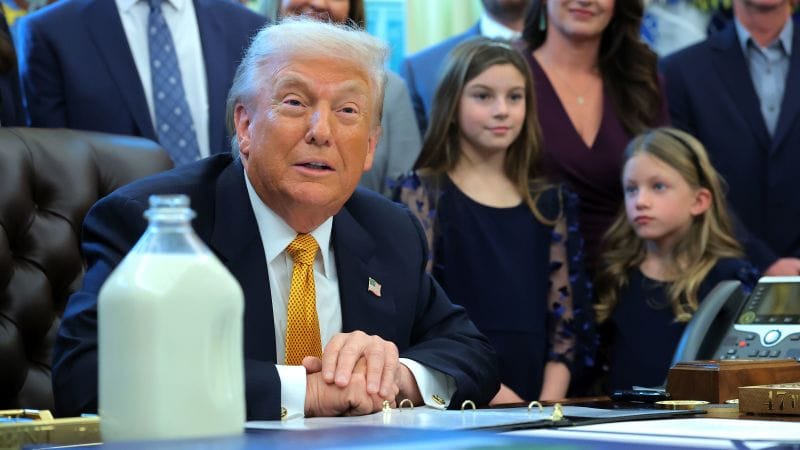
For more than a decade, the familiar sight of a full glass of whole milk, its creamy white liquid a staple of school lunch trays for generations, had been largely absent from American cafeterias. Students had grown accustomed to lower-fat alternatives, a reflection of evolving dietary guidelines aimed at promoting healthier eating habits. That era, however, has officially concluded.
On Wednesday, a significant policy shift unfolded when President Donald Trump signed a bill that reintroduces whole milk into school cafeterias across the United States. This legislative action reverses limits previously imposed on milk fat content in the National School Lunch Program, marking a notable departure from policies that had shaped children’s diets in schools for over ten years.
A Return to Tradition: The Milk Debate in Schools
The return of whole milk to school lunch menus is more than just a change in beverage options; it reignites a longstanding and often passionate debate about nutrition science, public health, and individual choice in the context of childhood development. For many parents, educators, and dairy farmers, the reintroduction is a welcome move, seen as restoring a natural and nutritious food option that had been unfairly removed. For others, particularly some public health advocates, it raises concerns about the potential impact on childhood obesity and cardiovascular health.
Prior to this reversal, federal regulations stemming from the Healthy, Hunger-Free Kids Act of 2010 had largely restricted milk options in schools to skim and 1% fat varieties. These regulations were championed by public health experts who pointed to rising rates of childhood obesity and the scientific consensus at the time that reducing saturated fat intake was crucial for heart health. The aim was to ensure that school meals, which serve millions of children daily, aligned with the latest dietary recommendations.
The Nutritional Tug-of-War: Whole Milk vs. Low-Fat
The nutritional profile of whole milk is at the heart of the debate. Whole milk contains approximately 3.25% milk fat, supplying fat-soluble vitamins like A, D, E, and K. Proponents argue that the fat content in whole milk contributes to a feeling of satiety, potentially reducing the likelihood of children feeling hungry shortly after lunch and seeking out less healthy snacks. They also emphasize that whole milk is a rich source of calcium, protein, and other essential nutrients vital for bone development and overall growth.
Furthermore, recent research has begun to challenge some long-held beliefs about dietary fats. While saturated fat was once broadly demonized, a more nuanced understanding is emerging, suggesting that the impact of dietary fats on health can be complex and depends on the overall dietary pattern. Some studies have even indicated that children who consume whole milk are not necessarily at higher risk for obesity, and in some cases, may even have a lower body mass index compared to those who consume low-fat milk, though more research is ongoing in this area.
Conversely, opponents of whole milk’s return emphasize that the higher calorie and saturated fat content could contribute to weight gain in children, particularly given the already high rates of childhood obesity in the U.S. and Europe. They argue that low-fat milk provides the same essential nutrients without the added fat, making it a healthier choice in a school setting where portion control and caloric intake are significant considerations. Organizations like the American Academy of Pediatrics have historically recommended 1% or skim milk for children over the age of two to limit saturated fat intake.
The National School Lunch Program: A Federal Framework
The National School Lunch Program (NSLP), which serves as the framework for this policy change, is a federally assisted meal program operating in public and non-profit private schools and residential child care institutions. It provides nutritionally balanced, low-cost or free lunches to more than 30 million children each school day. The program plays a critical role in combating food insecurity and promoting healthy eating habits among America’s youth.
Given its vast reach, federal regulations governing the NSLP have immense power to shape the dietary choices of a significant portion of the nation’s children. Over the past decade, these regulations had mandated specific nutritional standards for calories, sodium, saturated fat, and whole grains, along with the requirement for low-fat or fat-free milk options. The rationale was to leverage the program’s scale to instill healthier eating habits and contribute to a healthier generation.
Policy Reversal: Drivers and Debate
The Trump administration’s decision to reverse these limits aligns with its broader philosophy of deregulation and providing greater flexibility to states and local school districts. Proponents of the change often highlighted appeals from the dairy industry, which had seen a decline in milk consumption in schools, as well as advocacy from parents and some school officials who felt the previous guidelines were too restrictive and led to increased plate waste as children opted not to drink the lower-fat milk.
The argument for choice also played a significant role. Many believe that schools should offer a wider variety of options, allowing students and their families to make decisions that best suit their individual dietary needs and preferences. This perspective suggests that while nutritional guidance is important, an overly prescriptive approach can sometimes be counterproductive, leading to less engagement with healthy food options overall.
Potential Implications and Future Outlook
The immediate implication of this policy change is that schools participating in the NSLP now have the option to offer whole milk, alongside low-fat and skim varieties. It is not a mandate but rather an allowance, meaning local school districts will ultimately decide which milk options to provide. This local control aspect is a key feature of the policy reversal, empowering schools to tailor their menus to their student populations.
For students, the change might mean a return to a more familiar and perhaps more palatable milk option, potentially increasing overall milk consumption and the intake of associated nutrients. For the dairy industry, it represents a potential boost in sales and a reaffirmation of whole milk’s place in children’s diets. However, public health organizations are likely to continue monitoring the impact of this policy on student health outcomes, particularly concerning obesity rates.
This decision also serves as a microcosm of the larger, ongoing societal discussion about how best to balance public health directives with individual freedoms and economic considerations. It highlights the dynamic nature of nutritional science and the challenge of translating evolving scientific understanding into effective, broadly accepted public policy, especially when it concerns something as fundamental as feeding the next generation.
As the aroma of lunch fills school hallways once more, the choice of milk on the tray will signify not just a beverage, but a deeper conversation about the interplay of science, policy, and the enduring quest to nourish young minds and bodies effectively.