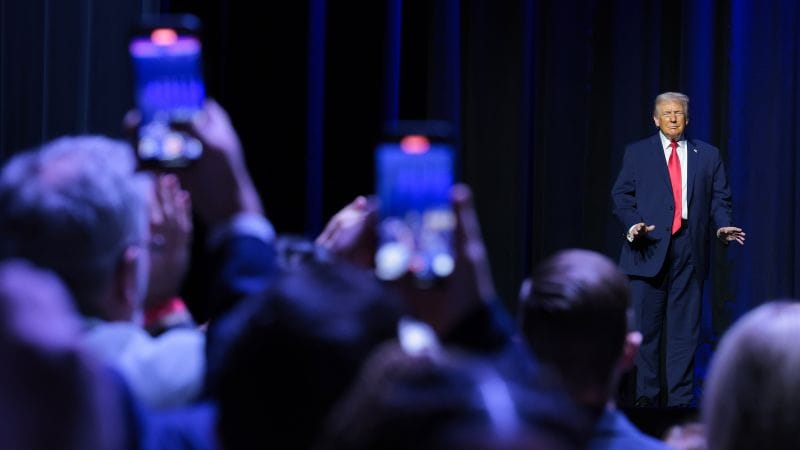
The roar of a Michigan crowd, a familiar scene of fervent support and unwavering belief, once again served as the backdrop for former President Donald Trump. In a recent address within the industrial heartland, Trump took to the stage to robustly defend his economic policies, particularly his stance on tariffs, and painted a picture of economic prosperity under his stewardship. Yet, as the echoes of his speech lingered, so too did a critical assessment from economic analysts and fact-checkers, scrutinizing the foundations of his claims.
At the core of the debate were assertions about the state of the economy: claims that inflation had ‘stopped’ or that consumer prices were ‘down,’ and that grocery prices were on a rapid decline. These statements, however, quickly met with counter-arguments from economic data, which indicate a more complex reality of ongoing price increases. Simultaneously, a significant poll conducted by WDIV/Detroit News gauged how Michigan voters perceive Trump’s economic handling, underscoring the critical role the economy plays in this pivotal swing state.
The Heart of the Matter: Economic Rhetoric in a Key State
Michigan, a state synonymous with American manufacturing and blue-collar resilience, often finds itself at the epicenter of national political discourse. Its unique economic tapestry, deeply woven with the automotive industry’s fortunes and the livelihoods of its skilled workforce, makes it a bellwether for the broader American economy. For presidential candidates, delivering a message that resonates with Michigan’s economic anxieties and aspirations is not merely strategic; it is often essential for victory.
During his address, former President Trump sought to tap into this very sentiment, positioning himself as a champion of American industry and a guardian against global economic pressures. His narrative centered on the idea that his past and proposed policies, including protectionist tariffs, are the necessary bulwark to safeguard American jobs and ensure domestic prosperity. Such rhetoric, while politically potent, often invites a deeper examination of the actual economic impacts.
The state’s historical dependence on manufacturing means that issues like trade imbalances, factory jobs, and global competition are not abstract concepts but tangible realities for many families. Therefore, promises of economic revitalization or warnings against foreign competition land with particular weight in communities that have experienced both boom and bust cycles. Understanding the nuances of Michigan’s economic landscape is crucial to interpreting the reception of such speeches.
Michigan’s Economic Landscape and Political Significance
Once an undisputed stronghold for the Democratic party, Michigan has emerged as a quintessential swing state in recent election cycles. Its electoral shifts often reflect underlying economic discontents and hopes, making it a prime battleground for candidates seeking to sway voters on economic policy. The automotive industry, though modernized and globalized, remains a powerful symbol of American industrial might, and any political discussion touching on its future carries significant weight.
The economic challenges faced by Michigan’s residents — from adapting to automation to navigating global supply chain disruptions — mean that economic policy debates are not just theoretical exercises. They directly impact employment prospects, wages, and the cost of living. This makes the state a crucial litmus test for how economic messages translate into voter sentiment and, ultimately, into electoral decisions.
Unpacking the Claims: Inflation and Consumer Prices
A central theme of the former President’s speech revolved around inflation and the cost of living, particularly grocery prices. He asserted that inflation had ‘stopped’ or was ‘down’ during his presidential term and that grocery prices were beginning to fall ‘rapidly.’ These claims quickly became points of contention, prompting fact-checkers and economists to compare them against prevailing economic data.
Inflation, as measured by the Consumer Price Index (CPI), reflects the average change over time in the prices paid by urban consumers for a market basket of consumer goods and services. While the rate of inflation has indeed fluctuated, general economic indicators confirm that consumer prices have continued to rise over the specified period, rather than stopping or declining overall. The distinction between a slowing rate of inflation and actual deflation (a decrease in the general price level) is critical for accurate economic communication.
Grocery prices, a particularly sensitive indicator for household budgets, have seen significant increases in recent years, driven by factors such as supply chain disruptions, labor costs, and global commodity price fluctuations. While some specific items might experience seasonal or temporary price reductions, the broader trend, as observed by major economic surveys and consumer reports, indicates an ongoing upward trajectory for food costs, albeit at varying speeds.
The Nuance of Economic Data Versus Political Rhetoric
The discrepancy between political claims and economic data highlights a common challenge in public discourse: simplifying complex economic realities for a broad audience. While a candidate might focus on specific, favorable data points, a comprehensive economic picture often requires examining multiple indicators over time, including core inflation, energy prices, and food costs, and understanding the methodologies behind these measurements.
For the average consumer, the feeling of inflation is often more personal than statistical. It’s reflected in the shrinking purchasing power of their dollar at the supermarket or the gas pump. When politicians discuss these issues, they tap into very real concerns, making the accuracy of their claims all the more important for voters trying to make informed decisions about their economic well-being and future.
The Tariff Debate: Who Pays the Price?
Another significant pillar of the former President’s economic defense was his staunch support for tariffs. He often frames tariffs as a tool to protect American industries and jobs, asserting that other nations, particularly China, bear the cost of these import duties. This perspective, however, largely contrasts with mainstream economic consensus regarding the incidence of tariffs.
Economists generally agree that tariffs, which are taxes on imported goods, are predominantly paid by domestic businesses and consumers in the importing country, not by the exporting nation. When the United States imposes tariffs on goods from China, for example, it is usually American importers who pay the tax to the U.S. government. These importers then often pass on those increased costs to American consumers through higher retail prices or absorb them, reducing their profit margins.
The trade wars initiated during Trump’s previous administration, particularly with China, led to the imposition of billions of dollars in tariffs on a wide range of goods. While proponents argued these measures would force other countries to fairer trade practices and boost domestic production, critics pointed to increased costs for American businesses, reduced consumer choice, and retaliatory tariffs from other nations that harmed U.S. exporters, particularly in the agricultural sector.
Global Trade Dynamics and Domestic Impact
The debate over tariffs extends beyond who directly pays the tax. It encompasses broader questions about global supply chains, international competitiveness, and the overall health of the domestic economy. While tariffs can offer temporary protection to specific industries, they can also lead to inefficiencies, stifle innovation, and complicate international relations.
The intricate web of global trade means that a tariff on one component or finished good can have ripple effects throughout various industries, potentially raising costs for manufacturers who rely on imported parts, or for retailers selling a variety of consumer goods. Understanding these complex dynamics is essential for evaluating the true economic impact of protectionist trade policies.
Michigan’s Economic Pulse: Voter Sentiment
Amidst the economic discourse, a poll conducted by WDIV/Detroit News offered a crucial glimpse into the minds of Michigan voters. The survey specifically asked residents how they felt about President Donald Trump’s handling of the economy, particularly in the context of his potential ‘second term’ or his economic legacy. Such polls are invaluable barometers, reflecting public approval or disapproval of a candidate’s core policy proposals and past performance.
For Michigan, where economic issues often decide elections, the results of such a poll can signal significant trends. Voters’ perceptions of economic well-being—whether they feel financially secure, optimistic about job prospects, or burdened by living costs—are powerful motivators at the ballot box. These sentiments are not always directly tied to macro-economic statistics but are often shaped by personal experiences and local economic conditions.
A candidate’s ability to convincingly articulate an economic vision that addresses these local concerns can be far more impactful than broad national statistics. The WDIV/Detroit News poll, therefore, provides a localized perspective on how Trump’s economic messaging resonates on the ground, offering insights into the challenges and opportunities for political campaigns in the state.
The Power of Perception in Electoral Politics
Public polls, while snapshots in time, are critical tools for understanding the prevailing mood of the electorate. They help delineate which economic issues are top-of-mind for voters and how different demographic groups are experiencing economic shifts. In a state like Michigan, a perceived strong economy can be a significant advantage for an incumbent or a candidate associated with past economic growth, while widespread economic anxiety can galvanize opposition.
The results of such surveys often inform campaign strategies, guiding candidates on which aspects of their economic platforms to emphasize and how to counter narratives from opponents. Ultimately, the economic track record and future promises are often the lenses through which voters evaluate leadership and make their electoral choices, especially in economically sensitive regions like Michigan.
The Role of Fact-Checking in Modern Politics
The swift reaction to the former President’s economic claims by fact-checkers highlights the increasingly vital role of independent journalistic scrutiny in contemporary political discourse. In an era often characterized by rapid information dissemination and the proliferation of various media sources, the verification of statements made by public figures has become paramount.
Fact-checking organizations and news wire services like Reuters and AP meticulously compare political rhetoric against official government data, academic research, and expert consensus. This process is not merely about identifying inaccuracies; it is about providing the public with reliable information, allowing voters to differentiate between policy proposals grounded in evidence and those based on questionable assertions.
The very titles accompanying the reports on Trump’s Michigan speech—such as ‘Fact check: Trump litters Detroit economic speech with numerous false claims about economy’—underscore the urgency and necessity of this journalistic function. It reflects a commitment to ensuring that public debate remains tethered to verifiable facts, enabling a more informed citizenry.
Ensuring Informative Public Discourse
The challenge for fact-checkers lies not only in debunking false claims but also in explaining the underlying economic concepts in an accessible manner. For instance, clarifying the difference between a declining rate of inflation and actual price decreases requires careful articulation to avoid further confusion. This educational aspect of fact-checking is crucial for elevating the quality of public debate and fostering a more sophisticated understanding of complex policy issues.
In a landscape where economic realities are often interpreted through different political lenses, the role of impartial fact-checking serves as a critical safeguard against misinformation, ensuring that the dialogue around crucial issues like inflation, tariffs, and economic growth remains anchored in empirical evidence.
“In the cacophony of political promises and economic anxieties, the challenge for voters remains to discern fact from rhetoric, to understand how grand policies translate into daily realities, and to choose a path that truly aligns with their aspirations for prosperity and stability.”