Nikki Glaser Signals Shift in Awards Show Strategy with Golden Globes Return
In a world where Hollywood frequently struggles to find successful formulas for sequels and reboots, Nikki Glaser returned to host the 83rd Annual Golden Globes ceremony, proving that continuity and a familiar face can sometimes be a successful strategy for high-stakes media events. Glaser, serving as host for a second consecutive year, leveraged a blend of sharp observational humor and celebrity roasting to anchor the ceremony, a format that has become increasingly vital for maintaining audience interest in a fragmented media landscape.
The decision to bring Glaser back for a second year represents a significant strategic choice for the Golden Globes organizers. Amidst declining viewership across most major awards shows, producers are under pressure to select hosts who can deliver reliable entertainment, generate viral moments, and navigate the delicate balance of humor in an industry increasingly sensitive to criticism. Glaser’s return suggests that her first outing established her as a reliable figure capable of delivering results for a second time, transforming her from a one-time experiment into a key component of the show’s identity.
The Market Demand for the Celebrity Roast
The Golden Globes have long been known for a more relaxed and irreverent tone compared to other ceremonies like the Academy Awards. This atmosphere allows for a specific type of humor known as the celebrity roast, where the host directly addresses and pokes fun at the high-profile attendees. Glaser’s monologue adhered closely to this tradition, as indicated by reports that stars visibly braced themselves in anticipation of her jokes. This high-wire act of comedy—balancing risk with entertainment value—is precisely what separates the Globes from its competitors.
The effectiveness of a host’s monologue is measured not only by the laughs generated in the room but, more importantly, by its performance on social media platforms in the days following the event. In today’s media ecosystem, a successful awards show often hinges on generating a few viral clips rather than maintaining consistent viewership across its entire runtime. Glaser’s reputation for pointed humor aligns perfectly with this trend, providing producers with a reliable source of content designed specifically for digital amplification.
For network executives and advertisers, a high-performing monologue with a high engagement rate offers tangible value. It ensures that the broadcast remains relevant long after it has concluded, providing a return on investment through sustained media coverage and online buzz. This shift in focus means that the traditional role of the host as a general entertainer is being replaced by the specialized role of the stand-up comedian, whose primary objective is to deliver high-impact, quotable moments.
Fashion and Spectacle: Beyond the Podium
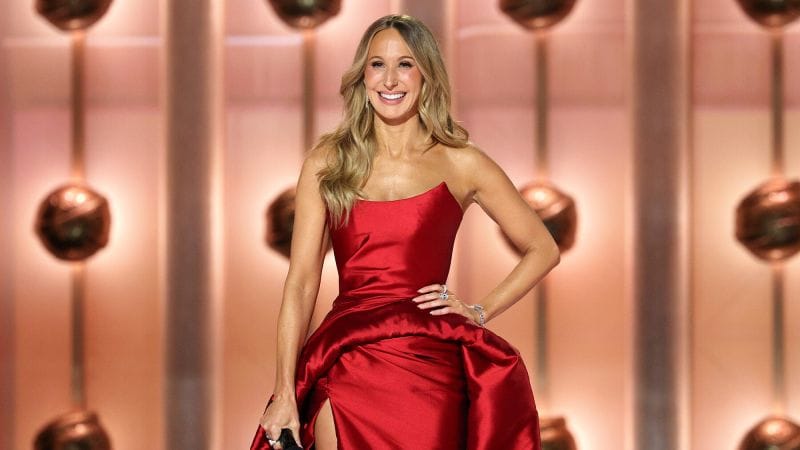
Beyond the monologue, the host’s physical presence and style choices are also critical components of the event’s overall spectacle. Glaser’s appearance in a prominent thigh-slit red dress was part of the broader visual strategy of the event. The red carpet portion of an awards show generates significant media coverage and advertising revenue in its own right, often serving as a preliminary event for the main broadcast. For a host, fashion choices are not merely personal preferences; they are an extension of the show’s brand.
The choice of a striking outfit for the opening monologue highlights the dual pressure on a host: to be both comedically sharp and visually compelling. This convergence of entertainment and fashion is particularly pronounced at events like the Golden Globes, where the mingling of film and television stars creates a unique marketplace for luxury brands and high-end fashion houses. The host’s appearance acts as an immediate visual signal to the audience, setting the tone for a night of glamour and entertainment.
In a saturated media market, every element of the broadcast, from the host’s jokes to their attire, is carefully considered to maximize audience engagement. The red dress, specifically noted in the event coverage, serves as a focal point for fashion critique and discussion, further extending the show’s relevance across different media platforms and demographics. This attention to detail demonstrates the meticulous planning required to ensure that a modern awards ceremony performs well both as live entertainment and as a post-event content machine.
The Broader Trend: Reboots and Stability in Media Hosting
The decision to bring back a successful host for a second year, described by some as a “reboot,” reflects a broader trend in media production. For many years, major awards shows experimented with different hosting formats, including rotating hosts, co-hosting pairs, or even going entirely hostless. The Golden Globes’ choice to anchor the show with a returning figure suggests a move toward stability in a volatile environment.
This market stabilization strategy is in direct contrast to the high turnover often seen in other major events. The Academy Awards, for instance, has struggled to find a consistent host in recent years, often prioritizing different strategies or relying on rotating teams of presenters. The Golden Globes’ decision to rely on a specific, proven talent for consecutive years indicates a strategy focused on building brand familiarity and audience loyalty, essential components for long-term commercial success.
For the audience, a returning host creates a sense of continuity and establishes expectations for the tone of the show. Audiences value knowing what to anticipate from an event, especially in an era where viewing habits are defined by on-demand content and personalized algorithms. A consistent host provides a counterpoint to the constantly changing nature of content consumption, offering a reliable, familiar experience that encourages live viewing.
Looking Ahead: The Future of Awards Show Hosting
The success of Nikki Glaser’s return will likely serve as a case study for future awards show producers. The market value of a host who can successfully manage a celebrity roast while maintaining industry relationships is high. As the entertainment industry continues to grapple with shifting audience preferences and the dominance of streaming services, the role of live events like the Golden Globes becomes more critical as a unifying force.
The future of awards show hosting will likely continue to evolve around the concept of specialized talent. Comedians with strong digital followings, who understand how to translate their humor effectively across different media platforms, are becoming the preferred choice over traditional entertainment personalities. Glaser’s performance underscores this transition, highlighting the ongoing effort to balance high-stakes live entertainment with the demands of a modern digital audience seeking shareable, impactful moments.
Ultimately, the challenge for awards show producers remains finding a balance between irreverence and respect, particularly in an era defined by increased cultural sensitivity and social media scrutiny. The ability of a host to navigate this terrain successfully, as Glaser demonstrated in her second outing, determines not only the night’s success but also the future viability of the entire event in a competitive media market.