Bitcoin Price Fluctuates Amidst Economic Uncertainty and Analyst Confidence
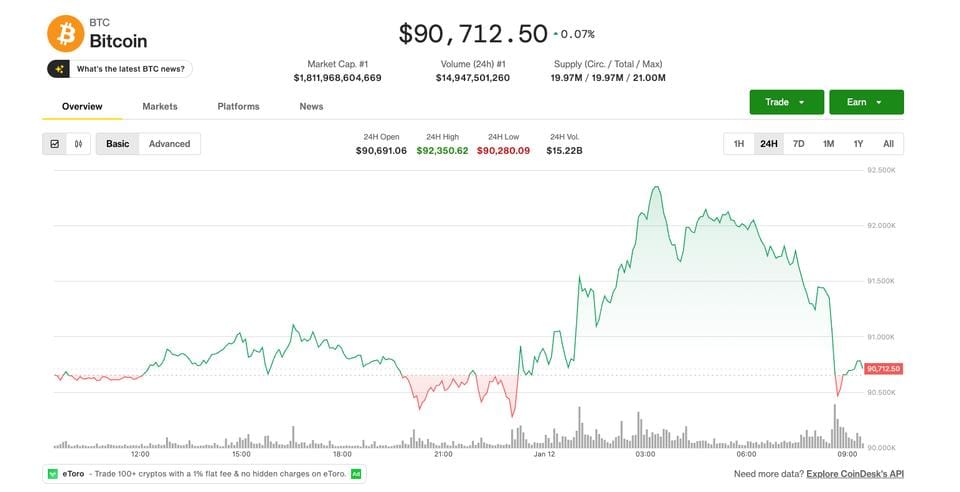
Bitcoin experienced a notable downturn, sliding back towards the $90,000 mark, a significant move that has captured the attention of investors and analysts alike. This price action occurred against a backdrop of intensified scrutiny over potential Federal Reserve rate cuts, a factor often closely watched for its influence on digital asset markets.
The cryptocurrency, known for its inherent volatility, saw its price dip on the day, marking a reversal from recent gains. This downward movement tested key support levels, prompting discussions about the underlying sentiment in the market. The $90,000 level represents a psychological as well as a technical threshold for many market participants.
Market Reacts to Shifting Economic Indicators
The week’s trading for Bitcoin has been marked by multiple catalysts for volatility, both within the cryptocurrency space and in the broader global economic landscape. The cryptocurrency bounced into the new week, showing initial resilience, but this was followed by a sharp trip above $92,000, which proved unsustainable.
Adding to the market’s complexity, Federal Reserve rate cut expectations have come under fire. Shifts in economic data and commentary from Fed officials can significantly alter market perceptions of monetary policy, directly impacting risk assets like Bitcoin.
The sentiment around Fed rate cuts is a critical driver for Bitcoin. Any indication of a slower-than-expected easing cycle can lead to a re-evaluation of asset prices across the board.
Citi Analysts Maintain Bullish Stance
Despite the recent downward price action, analysts at Citigroup (Citi) have reiterated their optimistic outlook on Bitcoin. They maintain a base case projection of $143,000 for the digital asset, a target that stands in stark contrast to the current market fluctuations.
This reiteration comes even as Bitcoin experienced a tumble of 2.3% over a 24-hour period. The analysts’ conviction suggests they believe the current price dip is a temporary correction rather than a fundamental shift in Bitcoin’s long-term trajectory.
Impact on Bitcoin ETFs
The broader market sentiment also appears to have affected Bitcoin Exchange-Traded Funds (ETFs). Reports indicate that Bitcoin ETFs also suffered on Wednesday, mirroring the broader price decline of the underlying asset.
The performance of these ETFs is often seen as a barometer for institutional interest and retail participation in Bitcoin. Their struggles highlight the current challenges facing the digital currency, even as institutional products offer more accessible entry points.
Factors Influencing Bitcoin’s Trajectory
Several key factors are at play influencing Bitcoin’s current trajectory. The ongoing debate about the Federal Reserve’s monetary policy is paramount. If the Fed delays or reduces the scope of its anticipated rate cuts, it could lead to tighter liquidity conditions, potentially dampening investor appetite for riskier assets.
Conversely, any unexpected positive economic news or a more dovish stance from the Fed could provide a tailwind for Bitcoin. The market is keenly observing inflation data, employment figures, and geopolitical developments for clues on the future path of interest rates.
The Role of Inflation and Monetary Policy
Historically, Bitcoin has been viewed by some as a potential hedge against inflation. However, its correlation with traditional risk assets, particularly technology stocks, has often been more pronounced in recent years. This suggests that macroeconomic factors, including interest rate policy, play a more dominant role in its short-to-medium term price movements than its ‘digital gold’ narrative.
The central bank’s actions are closely monitored. A pivot towards looser monetary policy, characterized by lower interest rates, typically makes assets like Bitcoin more attractive by reducing the opportunity cost of holding them and increasing liquidity in the financial system.
Analyst Projections and Market Expectations
The divergent views between short-term market sentiment and long-term analyst projections underscore the speculative nature of the cryptocurrency market. Citi’s $143,000 base case projection is based on a variety of factors, likely including their assessment of Bitcoin’s adoption rate, network effects, and potential as a store of value in the long run.
Such high-end projections often serve to instill confidence during periods of price decline, reminding investors of the potential upside. However, achieving these targets hinges on a confluence of positive market conditions and continued growth in Bitcoin adoption and utility.
The Evolving Landscape of Bitcoin ETFs
The introduction of spot Bitcoin ETFs in the United States earlier this year was hailed as a landmark development, significantly increasing accessibility for traditional investors. These products have seen substantial inflows, demonstrating a clear demand from both retail and institutional players.
However, the ETFs are not immune to the broader market’s ebb and flow. Their performance is directly tied to the price of Bitcoin, and periods of downturn can lead to outflows or reduced inflows, reflecting investor sentiment in real-time. The recent struggles of these ETFs underscore the current sensitivity of the market to macroeconomic news and Bitcoin’s own price dynamics.
Global Economic Factors at Play
Beyond the direct influence of U.S. monetary policy, global economic factors contribute to Bitcoin’s volatility. Geopolitical tensions, inflation rates in major economies, and the overall health of the global financial system can all impact investor confidence and capital flows into riskier assets.
As an asset that operates on a global, decentralized network, Bitcoin is susceptible to a wide array of international economic influences. Developments in Europe, Asia, and other major economic blocs can ripple through the market, creating opportunities or challenges for Bitcoin price appreciation.
Understanding Bitcoin’s Volatility
Bitcoin’s price is notoriously volatile, influenced by a complex interplay of supply and demand, regulatory developments, technological advancements, and macroeconomic trends. Understanding these drivers is crucial for investors seeking to navigate this asset class.
The recent price action, characterized by a slide towards $90,000, serves as a potent reminder of this volatility. While Citi’s long-term outlook remains bullish, the short-term trading environment is shaped by immediate market reactions to news and data.
The Road Ahead for Bitcoin
The coming weeks and months will be critical for Bitcoin as the market continues to digest economic data and anticipate central bank decisions. The ongoing debate surrounding Fed rate cuts will likely remain a dominant theme, influencing liquidity and investor risk appetite.
Market participants will be closely watching for any signs of capitulation or renewed buying interest. The resilience of Bitcoin above key support levels, coupled with sustained institutional interest through ETFs, will be crucial indicators of its future path.
Conclusion: A Market of Contrasting Views
In summary, Bitcoin finds itself at a crossroads, experiencing price declines amidst a cloud of economic uncertainty and scrutiny over monetary policy. Yet, in the face of this turbulence, prominent financial institutions like Citi maintain strong conviction in Bitcoin’s long-term potential, projecting significant upside.
This divergence highlights the dynamic nature of the cryptocurrency market, where short-term price action can be heavily influenced by immediate news cycles, while long-term value propositions are assessed over broader horizons. The performance of Bitcoin ETFs further reflects the current market sentiment, showing sensitivity to broader economic shifts.