The Liberty Bowl: A Harbinger of Doom for College Football?
Let’s just cut to the chase, shall we? This whole Liberty Bowl spectacle (Navy versus Cincinnati, mind you) isn’t just a game; it’s a glaring, neon-lit warning sign flashing right in our faces, a stark testament to the absolute chaos and impending implosion of college football as we once knew it. Forget the cheerful commentators and the pre-game hype, because what we’re witnessing here is less a celebration of amateur athletics and more a morbid autopsy of its rapidly decaying corpse. It’s a real train wreck, if you ask me, and everyone’s just gawking while the whole damn thing burns to the ground. (And we’re supposed to find this entertaining, right? What a joke.)
We’re talking about a world where ‘proven models’ from some SportsLine algorithm are dictating the narrative, rather than, you know, actual human insight or the unpredictable grit of young athletes. It’s sterile, it’s soulless, and it perfectly encapsulates the disturbing trend of reducing every human endeavor to cold, hard data points, sucking all the actual drama right out of the room. This isn’t just about picking a winner; it’s about the erosion of the very spirit of competition when some digital oracle pretends to know all the answers before the players even hit the field. It’s enough to make you just throw your hands up in exasperation, isn’t it?
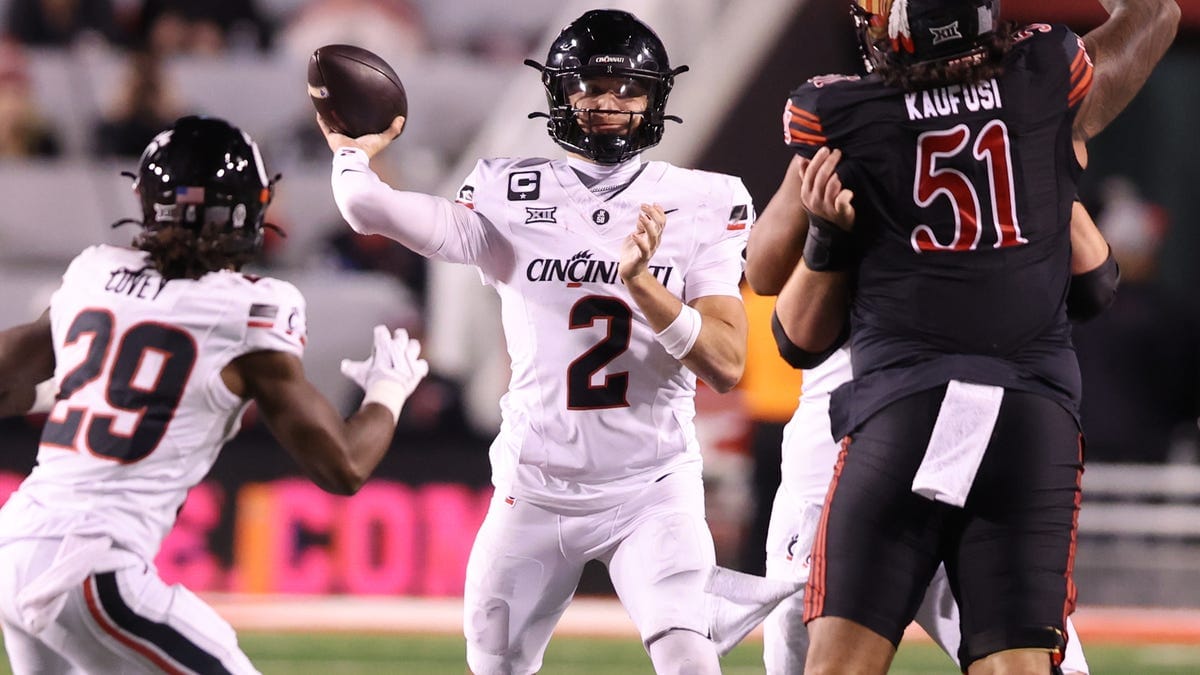
Brendan Sorsby’s Shadow: The QB Carousel of Despair
And then there’s the Brendan Sorsby saga, or more accurately, the ‘Is He Playing or Isn’t He?’ drama that has become an all-too-common preamble to every single major bowl game now. This isn’t just about Cincinnati’s quarterback plans; it’s a symptom, a screaming siren blaring the fundamental breakdown of player loyalty and institutional commitment that’s ravaging the sport. (Remember when players actually *wanted* to finish what they started?) It’s a sad state of affairs, truly, when the question of whether a key player will even show up for what’s supposed to be a marquee event hangs in the air like a foul stench, a testament to the transfer portal’s destructive power and the NIL’s corrosive influence.
Imagine, if you will, being a coach, pouring your heart and soul into a season, building a team, fostering camaraderie, only to have it all potentially unravel on the eve of your biggest game because a player (who, let’s be honest, might be eyeing greener pastures or a bigger paycheck) is playing coy. It’s a nightmare scenario, folks, an absolute mess that completely undermines the very foundation of team sports. What kind of message does this send to the younger players? That commitment is for suckers? That your personal brand trumps everything else? This isn’t character building; it’s career maneuvering, and it’s slowly but surely killing the soul of college athletics. The future looks grim, doesn’t it?
Cincinnati’s Illusion of Grandeur: The 7-1 Betrayal
Let’s not forget Cincinnati’s supposed ‘scorching 7-1 record’ and that fleeting No. 16 ranking in the US LBM Coaches Poll. Oh, the sweet taste of early-season success! But what happened after that, eh? The input just cuts off, conveniently, leaving us to fill in the blanks, which, let’s be honest, probably involve a spectacular flame-out, a catastrophic collapse from grace, or some other deeply disappointing sequence of events that landed them in a glorified exhibition game instead of contending for actual glory. (It always happens, doesn’t it?) This isn’t a success story; it’s a tragic fable about the fragile, fleeting nature of ambition in a landscape dominated by relentless pressure and the constant threat of a complete implosion.
That 7-1 record was just a mirage, wasn’t it? A cruel tease, a brief flicker of hope before the inevitable slide back into mediocrity, or worse. The weight of expectation, the relentless grind of a tough schedule, the psychological toll of balancing academics with elite athletic performance (if anyone even bothers with academics anymore, that is) – it’s all too much for these young men, and the system is designed to chew them up and spit them out. They start strong, they get a little taste of the big time, and then… *poof*. The magic’s gone, the wheels fall off, and suddenly the Liberty Bowl looks less like an honor and more like a consolation prize for a season that didn’t live up to its initial, glorious promise. It’s a classic setup for a fall, and boy, did they fall, I bet.
The ‘Meaningless’ Bowl Game: A National Tragedy
Now, let’s talk about the Liberty Bowl itself. This isn’t some hallowed ground where legends are forged; it’s just another cog in the bloated, corporate machine that college football has become. These bowl games, once a reward, a true capstone to a successful season, are now largely meaningless exhibitions, often populated by second-stringers and players who are desperately trying to avoid injury before heading off to the pros or the transfer portal. The very concept of ‘Liberty’ (a profound word, mind you) is being co-opted to brand a glorified scrimmage, a spectacle that barely registers with anyone outside of the most die-hard, delusional fans.
The financial implications for schools are astronomical, the demands on players are relentless, and the entertainment value for anyone not directly invested is plummeting faster than a lead balloon. We’re being fed this narrative of tradition and rivalry, but the reality is a stark, cynical money grab, an extension of the broadcast calendar, and a means to keep the cash registers ringing, consequences be damned. (And who pays the ultimate price? The fans, of course, who are left wondering why they even bother.) It’s a tragic state of affairs, making a mockery of what college sports once stood for, which, if we’re being honest, was always a bit of a romanticized fantasy anyway, but still, at least it had *some* pretense of purity.
Navy vs. Cincinnati: A Clash of Dying Ideals?
And what about the actual matchup? Navy vs. Cincinnati. It’s a clash of different worlds, isn’t it? The disciplined, tradition-bound ethos of a service academy against the more modern, perhaps more mercenary, approach of a Power Five (or aspiring Power Five) institution. Navy, with its triple-option offense, represents a bygone era, a stubborn refusal to fully embrace the pass-happy, spread-out future that dominates the game. It’s endearing, in a way, but also utterly impractical in the long run. (You can’t win consistently with nostalgia, folks.) They’re always the underdog, always fighting against the tide, and while admirable, it often feels like they’re just delaying the inevitable.
Cincinnati, on the other hand, represents the churn, the constant striving for relevance, the desperate attempt to climb the ladder in a conference landscape that shifts faster than quicksand. They had a taste of success, a brief moment in the sun, and now they’re back to proving themselves, again, potentially with a quarterback whose heart might already be elsewhere. It’s a microcosm of the entire college football ecosystem: one team clinging to tradition, the other desperately scrambling for survival and status, both operating under a cloud of uncertainty. The odds, the spread, the line… it’s all just numbers, a meaningless exercise when the underlying fabric of the game is unraveling at such an alarming pace. (Who really cares about a few points when the whole enterprise is teetering on the brink?) It’s enough to make you just shake your head in disbelief at the sheer absurdity of it all.
The Future of College Football: A Bleak Horizon
So, where does this all leave us? Staring into the abyss, if you ask me. The 2026 Liberty Bowl, whether it’s played next month or in a year, is just another data point in the accelerating decline. Player movement will only intensify, the financial disparities will widen, and the ‘proven models’ will become even more sophisticated, further dehumanizing the game. We’re hurtling towards a future where college football is indistinguishable from a minor professional league, where amateurism is a laughable relic, and where loyalty is a foreign concept. The ‘student-athlete’ is already an oxymoron; soon, it will just be a cruel joke.
The implications stretch far beyond the gridiron. What does it say about our society when institutions built on education and personal growth become mere talent factories, churning out disposable athletes for a ravenous entertainment industry? It’s a race to the bottom, folks, a relentless pursuit of profit that strips away all pretense of nobility or higher purpose. The very fabric of collegiate sports is tearing at the seams, and this Liberty Bowl, with its uncertain star quarterback and its algorithmic predictions, is just another tattered thread coming loose. (Don’t say I didn’t warn you when it all finally falls apart.) This isn’t just a game; it’s a societal warning, a big, flashing red light telling us that something is fundamentally broken in the way we approach competition, education, and the very concept of community. It’s truly a panic-inducing situation, and no one seems to be taking it seriously enough.