
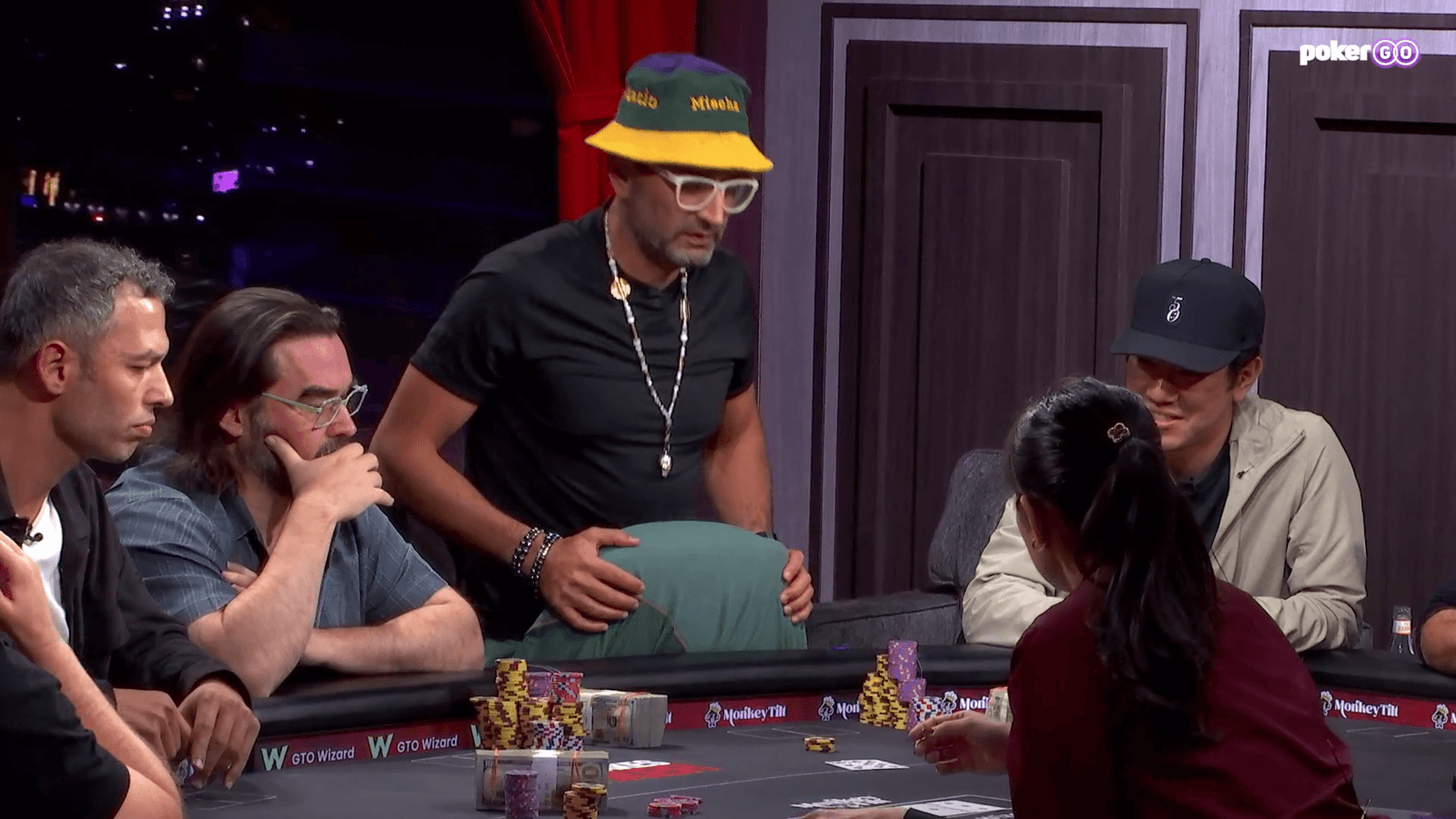
The Illusion of Skill: Esfandiari’s High Stakes Poker Spectacle
Let’s not get it twisted. When you hear about Antonio Esfandiari, ‘The Magician,’ returning to High Stakes Poker and winning one of the ‘sickest coolers ever’ for a staggering $824,000, you’re not witnessing a triumph of strategy or superior intellect. You are, in fact, consuming a manufactured spectacle designed to entertain the masses and make millionaires look like heroes, all while obscuring the fundamental, brutal truth of high-stakes gambling: sometimes, you’re just on the right side of pure, unadulterated luck.
The entire narrative around this hand, and around High Stakes Poker in general, is built on a foundation of misdirection. They want you to believe that these are titans clashing, using their razor-sharp minds to outwit each other for glory. But a ‘cooler,’ by its very definition, is the antithesis of skill. A cooler happens when two players are dealt extremely strong hands simultaneously, making it virtually impossible for either player to fold, regardless of how brilliant their reads might be. It’s the poker equivalent of a statistical anomaly, a preordained collision where the outcome is decided by the deck before the first card even hits the felt.
The Myth of The Magician: A Timeline of Deception
Esfandiari has always been an entertainer. His nickname isn’t just about his pre-poker career; it’s about his ability to create a persona that draws attention and makes the game look more glamorous than it truly is. His ‘triumphant return’ to High Stakes Poker was perfectly timed to capitalize on the nostalgia for the show’s glory days. But let’s look at the timeline. What we see on television isn’t real-time strategy; it’s heavily edited, highly produced content designed to maximize viewer engagement. The producers are looking for specific types of hands—those with high drama, those where the stakes are astronomical, and yes, those where a ‘cooler’ results in a massive pot change that makes the audience gasp. They don’t want a long, boring game of small-pot pre-flop raises; they want the $824k hand where someone gets absolutely devastated.
The very concept of a ‘cooler’ becoming a news story highlights everything wrong with how poker is presented to the public. Instead of celebrating a player who executes a brilliant bluff or makes a tough fold, we glorify a player who simply had a stronger hand when the cards fell that way. We’re celebrating variance, not skill. It’s like celebrating a lottery winner for having a good strategy. He’s not a magician; he’s just a rich guy who got lucky when the cameras were rolling. And we eat it up.
The Social Commentary: Bread and Circuses for a Broken Economy
Why do we care so much about this high-stakes circus? Because it serves a purpose for the media establishment and the entertainment industry. It’s a classic case of ‘bread and circuses.’ In a world where the average person struggles with inflation and stagnant wages, watching millionaires exchange hundreds of thousands of dollars in a single hand provides a brief, glittering distraction. It’s escapism for the masses, offering a glimpse into a world of wealth where problems seem trivial and fortunes are won and lost on the turn of a card. But let’s be honest, this isn’t just entertainment; it’s a social commentary on economic disparity. The people watching this show are, in many cases, people who would have their entire lives changed by $824k, while for Esfandiari and his peers, it’s just another day at the office. This disparity in value makes the spectacle feel less like a game and more like a gross display of excess.
The reality of high stakes poker is that a player’s long-term success is measured over hundreds of thousands of hands, not in a single, televised ‘cooler.’ This means the very format of the show is misleading. It prioritizes a single, dramatic moment over the painstaking, often boring, grind of consistent play. This hand, hailed as a ‘sickest cooler ever,’ isn’t just a win for Esfandiari; it’s a calculated victory for the show’s producers, who know exactly what kind of content will generate headlines and views. The celebration of this ‘cooler’ only serves to reinforce the idea that poker is a simple game of luck, which ironically undermines the very notion of a professional poker player’s skill set of skills.
The Timeline of Exploitation: From Underground Games to Televised Excess
Let’s trace the evolution of high stakes poker. It started in back rooms, in gritty, intense environments where real money was on the line, and the stakes meant something significant to the players involved. Then came the ‘poker boom’ in the early 2000s, where television turned it into a mainstream spectacle. Shows like High Stakes Poker were revolutionary because they brought the game out of the shadows, making players like Esfandiari household names. But with this increased exposure came a shift in focus. The ‘coolers’ became bigger, the pots grew larger, and the players developed personas specifically for the cameras. The authenticity began to bleed out, replaced by calculated performances for an audience that demanded constant entertainment.
The current iteration of High Stakes Poker is less about genuine competition and more about showcasing wealth. The players are almost always big-name professionals or very wealthy amateurs. They are playing for stakes that, for them, represent less risk than it would for a regular person playing at much smaller limits. This isn’t high stakes for them in the way it would be for someone trying to make a living; this is just another form of performance art. The $824k pot is massive, yes, but for Esfandiari, it’s a single data point in a career full of swings much larger than this. To present this as some kind of epic battle won by sheer skill is fundamentally dishonest.
Who benefits from this narrative? Not the novice player trying to learn the game. They see a ‘cooler’ and internalize the idea that luck is all that matters, leading them to play poorly and lose money. The only beneficiaries are the high-stakes players who are cashing in on media appearances and the producers who are generating advertising revenue from the spectacle. The ‘Magician’ returns, and a new generation of viewers falls for the illusion that poker is all about one big, exciting hand rather than the monotonous, strategic grind of thousands of hands.
The Future: When the Spectacle Becomes Boring
Where does this go next? The problem with constantly escalating the spectacle is that the audience quickly becomes desensitized. Today’s ‘sickest cooler’ is tomorrow’s forgettable hand. How long before a million-dollar pot isn’t enough to capture our attention? The stakes will have to keep rising, pushing the boundaries of what’s considered normal, until the whole thing collapses under the weight of its own excess. The truth is, high-stakes poker television is reaching a point where it’s no longer about the game itself but about the raw display of wealth. It’s a race to see who can make the most ridiculous, high-variance play to gain attention. And Esfandiari’s cooler win, while spectacular, only accelerates this inevitable decline into a form of entertainment where genuine skill is an afterthought.
Don’t fall for the hype. The ‘Magician’ may have won the hand, but the real magic trick here is convincing you that this spectacle actually matters. We should be focused on economic inequality and genuine meritocracy, not on a wealthy gambler who got lucky in a TV show. It’s time to pull back the curtain and see this for what it really is: a distraction, a performance, and nothing more.

Photo by MariamS on Pixabay.