The Digital Illusion of Progress: Why a 5-Yard Gain Signals Societal Decay
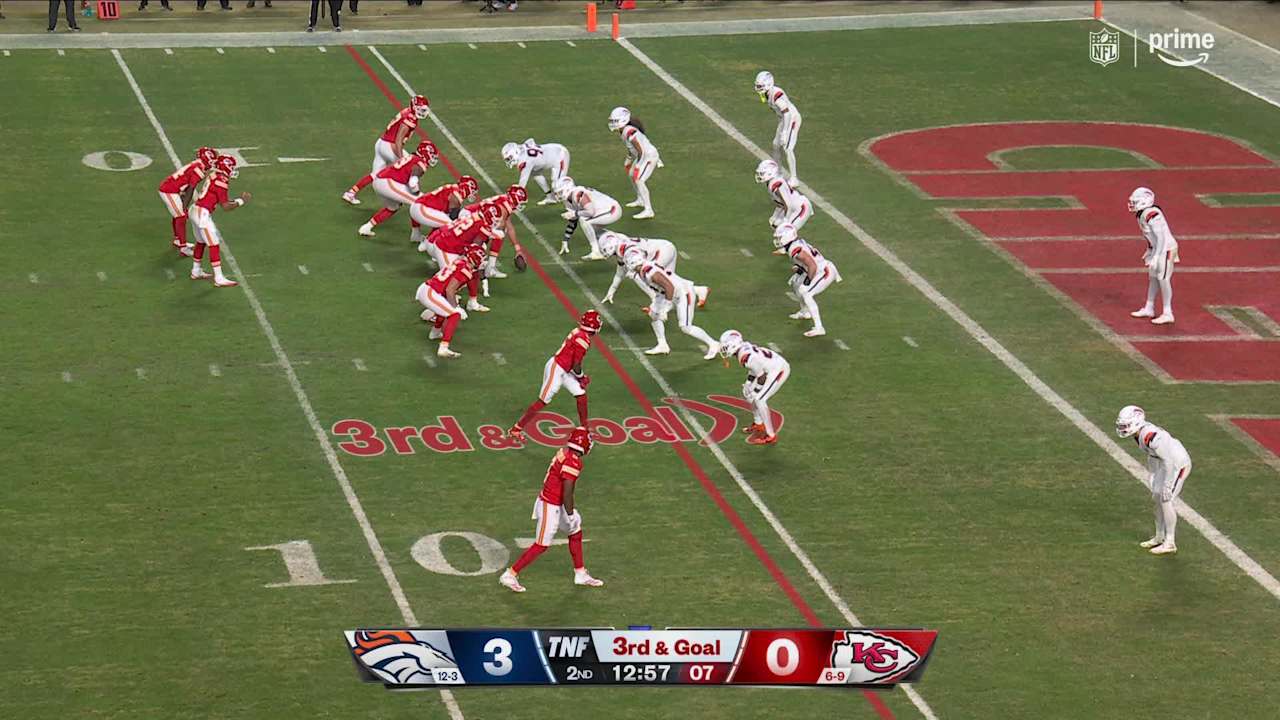
Let’s talk about the Kansas City Chiefs, not because I care about the trajectory of their football (which, let’s be honest, is just another distraction tailored to keep the masses pacified), but because their game highlights—specifically these hyper-fragmented clips detailing things like Kareem Hunt’s crucial 5-yard, fourth-down conversion—perfectly illustrate the catastrophic erosion of contextual reality driven by Silicon Valley’s ravenous hunger for attention. You see a momentary success, a digital breadcrumb, engineered specifically to be consumed in the three seconds you have between refreshing your social feed and staring blankly at the wall, and this relentless focus on micro-successes—a five-yard conversion here, an eleven-yard catch there—is precisely the kind of low-effort, high-octane digital crack cocaine that our decaying attention spans crave, reducing the grandeur of a three-hour strategic battle into a series of flickering, isolated data points perfectly optimized for consumption on the smallest screen imaginable while you pretend to be paying attention during a Zoom call (which, let’s be honest, is probably also crashing). It’s all junk food.
We’re being conditioned, folks.
(And I mean conditioned by the machines, not by the coaches).
This isn’t about celebrating a tough run; it’s about validating the underlying technology that decided you needed to see this particular play at this exact moment, stripping away the preceding eleven penalties, the failed defensive scheme, and the sheer fatigue of the linebackers, thus presenting an antiseptic, easily digestible narrative of ‘victory’ or ‘progress’ that requires zero critical thought, which is exactly how the digital overlords like it because complexity interrupts engagement metrics. Hunt’s run, which admittedly gets the job done on the field, is the quintessential example of a modern-day highlight: short, impactful, perfectly loopable, and utterly devoid of the narrative friction that makes true sport (or true life) worth watching, but don’t take my word for it; just scroll down another centimeter and see how quickly your brain discards this crucial moment for the next shiny digital bauble. They control the narrative.
The Tyranny of the Immediate: Travis Kelce and the Fragmented Feed
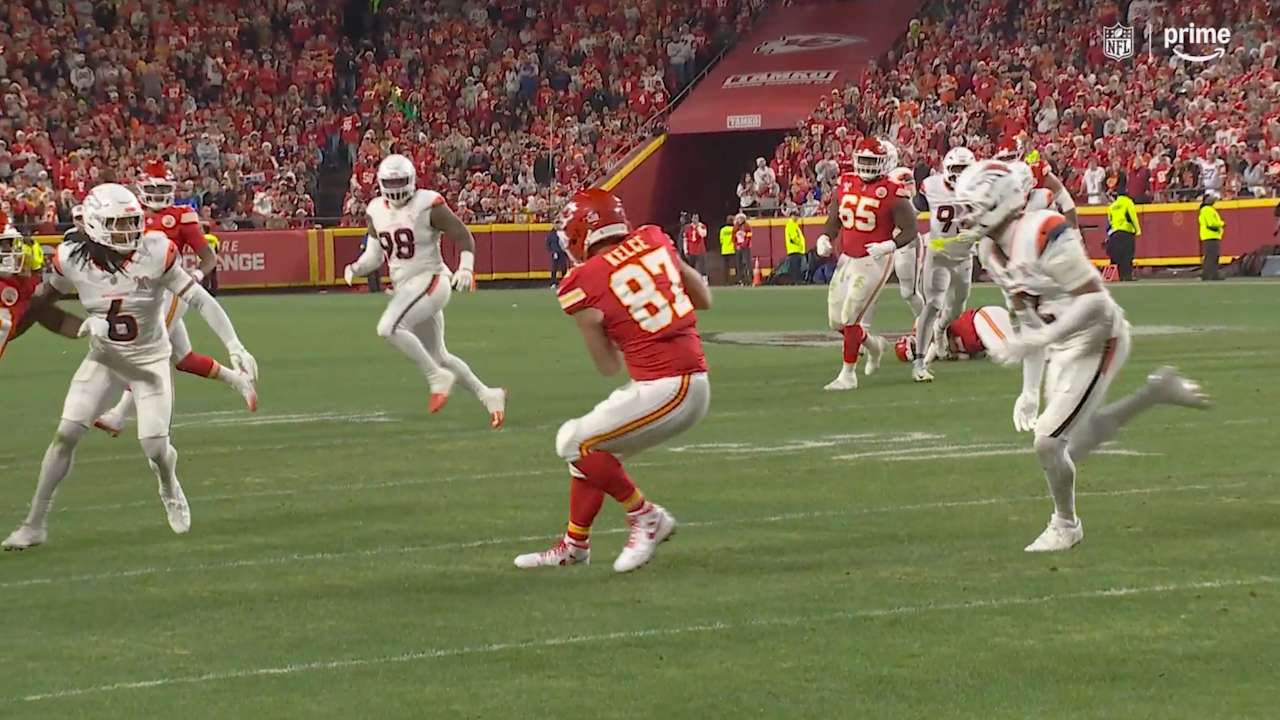
Now, look at the other featured moments: Travis Kelce’s first reception yielding 11 yards and Brashard Smith breaking a tackle on his way to the end zone. These are not standalone masterpieces; they are pixels in an ocean of noise, and the fact that we isolate them, label them, and treat them as definitive moments reveals the deep pathology of the content economy that dictates every waking breath we take, forcing us to believe that success is only measured in discrete, quantifiable bursts rather than sustained effort over time (a philosophy that has disastrous implications far beyond the gridiron, influencing everything from political cycles to the way we manage infrastructure). Just think about it.
If you were actually watching the game—the whole kit and caboodle—Kelce’s 11 yards is a setup, a building block. But when it’s delivered to your device via an alert, it becomes a ‘highlight,’ demanding a dopamine hit, and the moment you click, you are validating the AI’s decision to prioritize that single play, feeding the beast information about what keeps your eyeballs glued to the screen, which further empowers the algorithm to chop, slice, and dice reality into ever smaller, more meaningless, profit-maximizing snippets of visual disarray. We are voluntary cogs in the attention machine, and the whole system is designed to keep us scrolling endlessly, looking for the next fleeting rush, never satisfied, always hungry for the next isolated datum, whether it’s a touchdown run or a picture of somebody else’s perfect breakfast. The whole process drives me up the wall.
The Brashard Smith Problem: Are We Just Training the AI?
The Brashard Smith clip—the broken tackle, the sprint to the end zone—is undeniably athletic, a visceral, human moment of triumph, but here is my hot take, my truly provocative observation that flies in the face of modern digital fandom: these clips aren’t for you, they are for the machines that will eventually replace the analysts, the referees, and possibly the players themselves, because every time an NFL Game Highlights Presented By tag is slapped onto a clip, it is not just advertising a soft drink or a telecom company; it is labeling a data point for advanced machine learning models that are studying human reaction time, leverage, and decision-making under stress in real-time, far more effectively than any human coach ever could. Smith’s tackle break, the precise angle of his shoulder, the subtle shift in his center of gravity—that is priceless biometric and kinematic data being fed into systems that will eventually optimize the entire league, potentially stripping away the chaotic humanity that makes sports worth watching in the first place, turning it into a sterile, perfectly efficient digital spectacle.
We need to seriously grapple with the implications of this hyper-curated video consumption model, especially as AI continues to infiltrate every aspect of our existence (from writing news articles to driving our autonomous vehicles), because what happens when the computer system, having ingested millions of these perfect micro-moments, becomes better at predicting, scripting, and even simulating the ideal football play than the human beings on the field? The moment the digital twin of the league, built on the back of these thousands of isolated highlight reels, becomes more profitable and engaging than the messy, unpredictable human version, we are truly cooked. That’s the cliff edge we’re racing toward.
The technology that delivers these plays—the ultra-high definition streaming, the instant mobile alerts, the predictive algorithms—is inherently fragile and fundamentally corrosive to sustained thought, leading us down a path where we can only process information in 15-second bursts, which is a disastrous cognitive state for navigating a complex world full of non-highlight-worthy problems like climate change or geopolitical instability. It’s an attention deficit disorder made manifest and monetized, and football is just the delivery vector.
The Digital Dark Ages: A Prediction of Collapse
We are currently living through a golden age of convenience—instant access to Kareem Hunt’s every stride, delivered seamlessly through a tiny slab of glass—but this age is built on a foundation of shifting sand, entirely dependent on complex, delicate infrastructure that is incredibly vulnerable to everything from solar flares to targeted cyberattacks (a vulnerability that our focus on the immediate, fragmented highlight reel blinds us to entirely, convincing us of a false sense of perpetual technological stability). Imagine a scenario, just for a second, where the servers running the streaming architecture fail, where the internet backbone cracks, or where the simple ability to send a push notification detailing Travis Kelce’s 11-yard gain vanishes: suddenly, that hyper-curated, isolated moment loses all relevance because it cannot be instantly shared, liked, and validated by the swarm. The moment the digital delivery system goes offline, the highlight reels—the meticulously labeled, AI-ready fragments of the game—will rot on a hard drive somewhere, confirming that the perceived reality of the digital age is terrifyingly ephemeral.
We treat these moments, these ephemeral clips, as if they are history written in stone, forgetting that they only exist because a multi-billion dollar conglomerate decided it was profitable to extract and distribute them in this particular format, and the second that profit model shifts, the whole digital house of cards comes tumbling down, leaving us with a collective attention span that can’t handle anything longer than a Vine, desperately searching for the next fix that will never come. The ability to watch a game, start to finish, without interruption or the constant compulsion to check a second screen for ‘expert’ commentary or immediate highlights, is a skill we are rapidly losing, replaced by the twitchy dependency on the next notification, the next algorithmic recommendation, the next isolated play that the machine believes is necessary to keep our engagement levels optimized. It’s a sad state of affairs.
So, the next time you see Brashard Smith blast into the end zone, don’t just see the score; see the data extraction, see the algorithmic control, and see the technological fragility that ensures this fleeting moment will quickly be superseded by something even shorter, even faster, and ultimately, even more meaningless. Because until we unplug and remember how to process context, we are just digital serfs staring at the micro-successes our masters permit us to see (and they are always watching us watching, cataloging our reactions for future exploitation). It’s time to look past the screen.
Turn it off.
Unplug the whole damn thing. That’s my final thought on this digital clown show (and yes, that includes the NFL).