
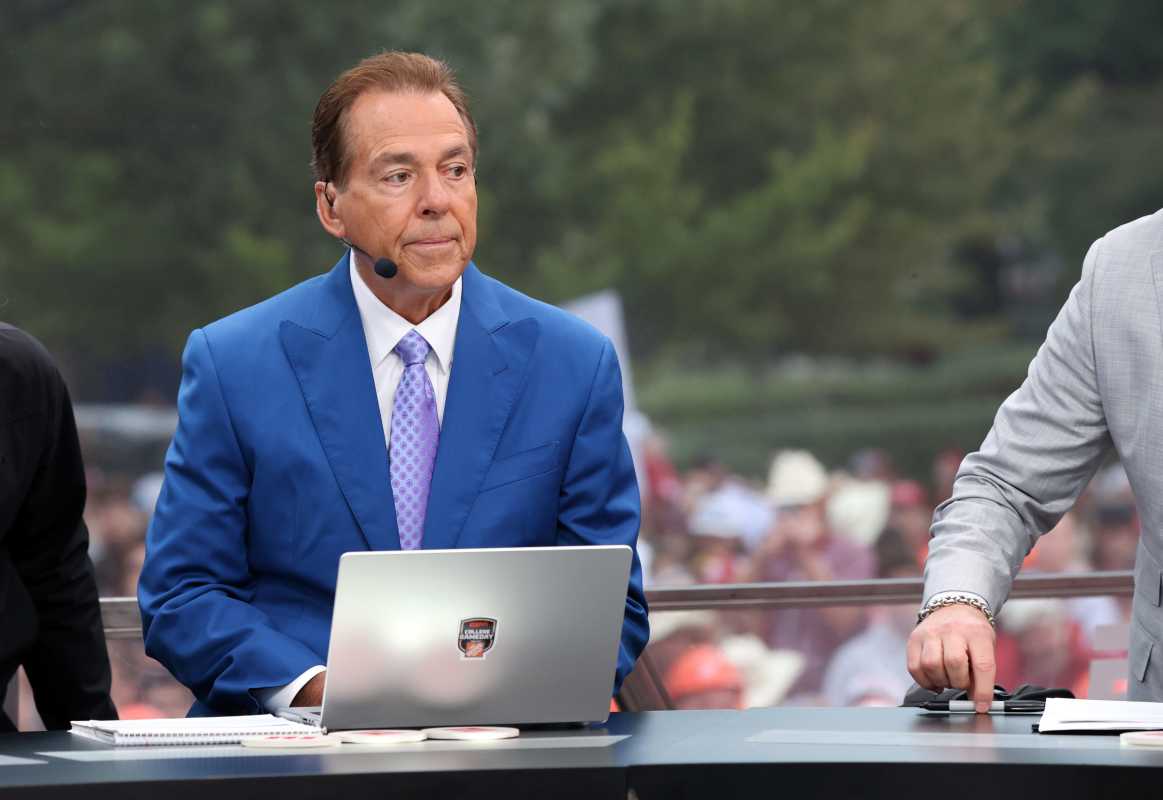
Nick Saban’s Final Act: The Whining Curmudgeon
Ah, the sweet sound of Nick Saban, post-retirement, continuing to dominate the news cycle. The man just couldn’t resist. He’s like that uncle who retires and then shows up at every family gathering to critique the way everyone else is doing things, even though he’s supposed to be relaxing and playing golf. The new controversy? Saban, with all the grace of a toddler denied a cookie, has decided to accuse Texas A&M of piping in artificial crowd noise during their games at Kyle Field. It’s truly a magnificent spectacle of human pettiness, a grand finale from the undisputed king of college football who simply cannot stand the idea that something, anything, might be happening in the sport that he doesn’t control or hasn’t already mastered.
This accusation arrives at the perfect moment in the college football season, just as Texas A&M prepares to host a College Football Playoff game, a truly pivotal moment for a program desperate for validation. Saban’s claim essentially questions the very foundation of the Aggies’ famed home-field advantage—the “12th Man”—by suggesting it’s not organic human passion, but rather a carefully engineered soundscape designed by technicians in a booth. It’s a jab straight to the heart of A&M’s identity, a direct challenge to their self-proclaimed status as having one of the loudest stadiums in the nation, which, let’s face it, is exactly what makes this whole thing so much fun to talk about.
The Great Debate: Saban’s Hypocrisy vs. A&M’s Desperation
Q: Is Nick Saban’s complaint valid or just sour grapes?
Let’s cut through the noise, shall we? This is less about a potential rule violation and more about Saban’s deeply ingrained belief that the world should operate exactly as he sees fit. For decades, Saban benefited from a system where Alabama consistently had top-tier talent, state-of-the-art facilities, and essentially unlimited resources. He built a dynasty on the idea that every advantage, no matter how small, must be exploited, yet now that he’s on the outside looking in, he suddenly becomes the arbiter of ethical conduct. It’s the ultimate “I’m a good sport, as long as I win” mentality, and frankly, it’s hilarious when you consider the history between these two programs and their coaches.
Remember Jimbo Fisher, the former A&M coach, who tangled with Saban over accusations of “buying” players with Name, Image, and Likeness (NIL) money? Saban threw shade, Fisher threw shade, and the whole thing turned into a public spectacle that defined the rivalry for years. Now Saban is back, accusing A&M of a new kind of cheating. This isn’t just a random accusation; it’s a continuation of a bitter personal and professional rivalry that transcends the actual game. Saban just can’t resist taking one last swing at the program that dared to challenge his dominance in the SEC, even if the weapon he’s choosing to use is a complaint about stadium acoustics.
The man who oversaw the most dominant dynasty in college football history, a program where every aspect was optimized to within an inch of its life, is now complaining about the home team trying to optimize its crowd noise. It’s rich, really. It’s like a supervillain complaining that the hero has a slightly better utility belt than he does. He built his kingdom on psychological warfare and strategic advantages, and now he’s claiming foul when another team uses a different weapon. Pathetic.
Q: Is A&M actually doing anything wrong by piping in noise, or is this just standard practice?
Let’s be real: college football is a high-stakes, multi-billion dollar business disguised as an amateur sport. The idea that teams aren’t exploring every single technological advantage possible—including manipulating sound—is naive. Stadiums across the country are designed not just for viewing, but for creating an atmosphere. They are architectural marvels specifically engineered to amplify sound, and in some cases, to add sound. The line between natural crowd noise amplified by stadium architecture and artificial noise added to the mix is incredibly blurry, especially in a world where every stadium has a powerful sound system for music, announcements, and advertisements.
Texas A&M’s fans, the “12th Man,” take immense pride in their ability to disrupt opponents. They’ve built an entire culture around being loud. But in a modern stadium environment, where teams use sophisticated techniques to counter crowd noise (like silent counts or advanced communication systems), it makes sense that the home team would try to find ways to maintain its advantage. If Saban is correct, A&M isn’t cheating; they’re simply adapting to the technological arms race that defines modern college football. Why should noise generation be treated any differently than high-tech training equipment or advanced nutrition programs? It’s all part of the game.
However, if A&M truly is adding artificial noise during plays—a key part of Saban’s accusation—then that crosses a line. It transforms a natural, fan-generated advantage into an orchestrated, potentially rule-violating tactic. But good luck proving it. The way these things work, it’s always just loud enough, just close enough to the ambient noise, that proving intent beyond a reasonable doubt becomes nearly impossible. It’s a genius move, really, if you’re willing to live in the gray area of ethics.
The Broader Implications: Integrity, Arms Races, and the Future of Noise
Q: What does this noise controversy say about the state of college football integrity?
Integrity in college football is an oxymoron, a punchline. The sport is in a state of chaos, driven by NIL money, the transfer portal, and conference realignment that favors television networks over tradition. To complain about crowd noise in this environment is like complaining about a spilled drink on the Titanic; it completely misses the point of the much larger catastrophe occurring around us. The game has always been about bending the rules to the breaking point. Whether it’s recruiting advantages, sign stealing (which Saban himself was accused of during his career, though never proven), or now, sound engineering, teams are going to find a way to gain an edge.
The real issue isn’t the noise itself, but the fact that Saban feels entitled to point it out. It highlights the inherent hypocrisy in a sport where everyone claims to be about “amateurism” and “fair play,” but everyone knows it’s a cutthroat business where billions are on the line. The very idea that A&M might be cheating with noise is a minor infraction compared to the systemic issues of pay-for-play that have fundamentally altered the landscape of college sports. If Saban wants to clean up college football, he needs to look at the massive amounts of money flowing to players and coaches, not just the decibel levels at Kyle Field.
The accusation about A&M’s noise essentially boils down to: “My advantage in recruiting and coaching was earned, but your advantage in home field acoustics is cheating.” It’s a convenient narrative that allows Saban to maintain his moral high ground while simultaneously taking a jab at a rival. He’s essentially saying that A&M’s home field advantage isn’t authentic, thereby undermining any future success they might have in the playoff. It’s a clever, if slightly desperate, psychological tactic from a man who understands how to manipulate public perception better than anyone else in the game.
Q: Will this accusation lead to a change in rules regarding sound in stadiums?
It’s possible, but unlikely to be effective. The rules are already vague. The NCAA rule book essentially states that home teams cannot use artificial means to enhance crowd noise in a way that interferes with the opposing team’s communication. But how do you prove it? In an environment where every stadium has a sound system, and crowd noise is naturally loud, determining whether a specific sound byte or amplification technique constitutes a violation is nearly impossible. The NCAA would have to install decibel monitors and analyze sound frequencies in real-time during every game, which is simply not feasible given their current operational limitations.
Instead, what this will likely do is accelerate the technological arms race. Other teams will now be looking at A&M, saying, “If they can get away with it, why can’t we?” The next generation of stadium design will focus even more on acoustic advantages. We might see a future where teams openly boast about having the most technologically advanced sound systems designed to make opponents miserable. This isn’t a scandal; it’s an innovation. It’s the natural progression of a sport that constantly seeks new ways to gain an edge. Saban’s complaint isn’t stopping the future; it’s just highlighting the absurdity of it all.
Ultimately, the accusation from Nick Saban about Texas A&M’s crowd noise is a gift to the media, a high-drama storyline that gives us something to argue about besides the actual quality of play. It’s a perfect microcosm of modern college football: loud, chaotic, fueled by ego, and completely lacking in a clear sense of right or wrong. And frankly, that’s exactly why we love it so much. Saban. He understands that controversy sells, and even in retirement, he’s still providing us with the content we crave. Keep complaining, Nick. It’s far more entertaining than most of the games anyway.
