The Anatomy of an Excuse: Why Barcelona’s Security Claim Rings False
When FC Barcelona announced a 30-minute delay for their match against Guadalajara, the official line was immediately deployed: “security reasons.” And just like that, the public was expected to accept this vague, catch-all phrase as a satisfactory explanation for a breakdown in professional logistics. But let’s deconstruct this narrative for what it truly is: a flimsy-thin veil of public relations spin designed to shield a massively expensive footballing institution from the embarrassment of simple incompetence.
Because when you peel back the layers, the claim of a sudden security threat requiring a precise 30-minute buffer just doesn’t withstand scrutiny. If there were genuine, immediate threats to player safety or crowd control, the match would be postponed indefinitely, or at the very least, moved to a different time or location, not merely nudged back by half an hour. The precise, calculated nature of the delay screams ‘contractual obligation’ or ‘logistical screw-up’ far louder than it does ‘existential security crisis.’ It’s the kind of timing you see when a high-value television broadcast slot needs to be met, or when a high-profile team (which, let’s face it, is always fashionably late) hits unexpected traffic. The club needed to cover its tracks, and ‘security’ is the safest word in the corporate lexicon to do so.
The Arrogance of ‘All the Artillery’ vs. The Reality of Rotation
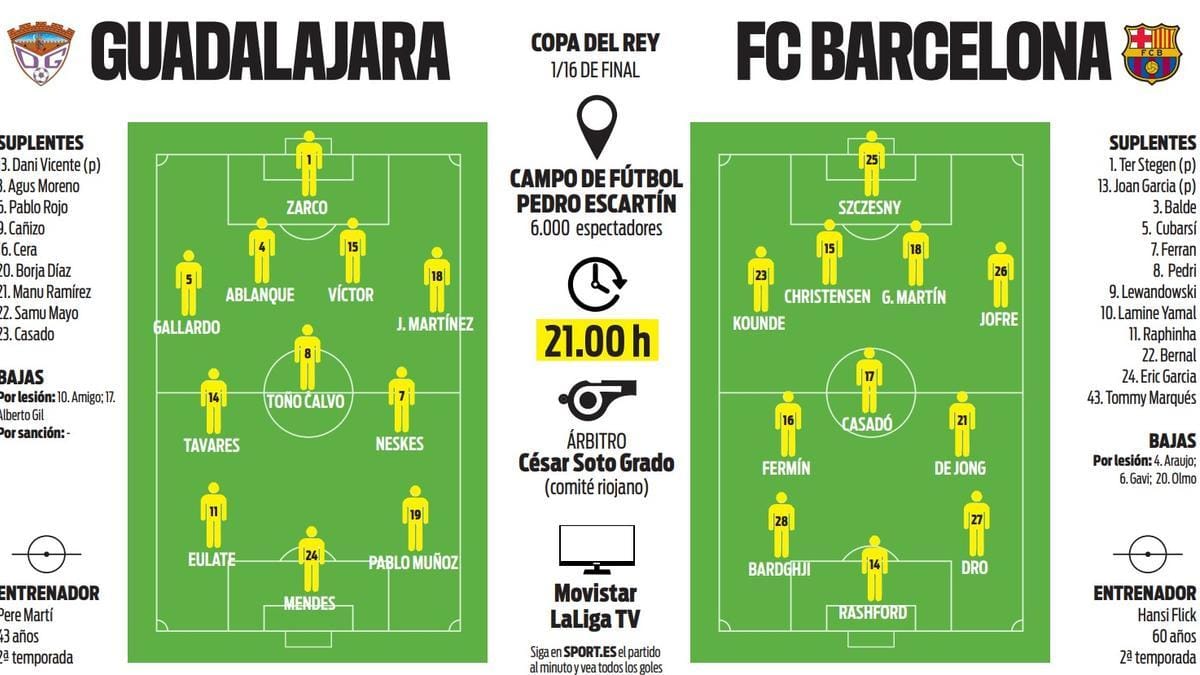
But the real hypocrisy here isn’t just the delay; it’s the context surrounding the match itself. The club’s strategy for this ‘Copa’ game—likely a lower-tier cup match against a less-heralded opponent—is a study in contradictory posturing. We read about ‘mass rotation’ alongside the claim that they will bring ‘toda la artillería a Guadalajara.’ This is not a strategy; it’s a contradictory press release designed to appease both the fans who demand the stars, and the coaching staff who want to rest them.
So, why bring ‘all the artillery’ if the plan is to rotate massively? The answer, naturally, lies in brand marketing. FC Barcelona understands that their brand value is tied to the presence of their marquee players, regardless of how many minutes they actually play. The ‘artillery’ isn’t there to win the match; it’s there to sell tickets, merchandise, and TV viewership rights. The players are props in a larger commercial enterprise, and their travel to a location like Guadalajara (whether in Spain or Mexico) becomes a marketing event in itself. The delay, therefore, likely involved coordinating this spectacle—perhaps a star player arriving late due to a personal appearance obligation that took longer than expected, or a TV crew struggling to set up for a pre-game show that requires specific shots of those aforementioned ‘artillery’ players.
Deconstructing the Goalkeeper Morbidity: Symptom of Institutional Instability
The source data even mentions the ‘morbidity’ surrounding the choice of goalkeeper for the Copa match. This small detail, tucked away in the press coverage, reveals more about the club’s institutional instability than any headline. A well-run club would have a clearly defined pecking order, where the second-choice goalkeeper is trusted to handle cup duties without creating drama or ‘morbid fascination.’ The fact that this decision generates such intrigue highlights a lack of confidence in the backup keeper, a perceived weakness in the roster depth, or internal power struggles that undermine clear decision-making. It’s a symptom of a club that is not a cohesive unit but rather a collection of high-priced, individualized brands operating under a single umbrella. The delay, therefore, becomes less of an isolated incident and more of a predictable consequence of this underlying disorganization.
The Logical Deconstruction: The Real Reason Behind the Delay
Let’s set aside the vague ‘security reasons’ and apply some basic logic. A 30-minute delay in a football match of this nature is almost exclusively a logistical problem, not a security one. The most probable culprits are:
- **Traffic and Travel:** Barcelona’s high-profile entourage (the ‘artillery’ and support staff) often requires complex logistical arrangements. If they flew into the city late or encountered unforeseen traffic, the club would certainly not want to admit that simple gridlock could throw off their schedule.
- **Contractual Obligations:** The match might be part of a larger sponsorship deal or television rights package. A specific window for pre-match analysis or promotional material may have been missed, requiring a delay to keep all stakeholders happy.
- **Player Preparation:** Given the ‘mass rotation’ strategy, perhaps certain players were given specific rest times that conflicted with the original schedule, or perhaps a pre-match press conference went over time. The club prioritizes its brand over timely logistics.
And so, we return to the core truth: The delay wasn’t about a threat; it was about incompetence. The club, in its usual arrogant fashion, assumes that its fans and the press will simply swallow the excuse without question. It’s a classic case of PR over substance, where a minor inconvenience for fans actually exposes a major flaw in the organization’s core operations. And because this is FC Barcelona, everyone pretends not to notice, because who wants to criticize the ‘artillery’ when they’re finally on display?