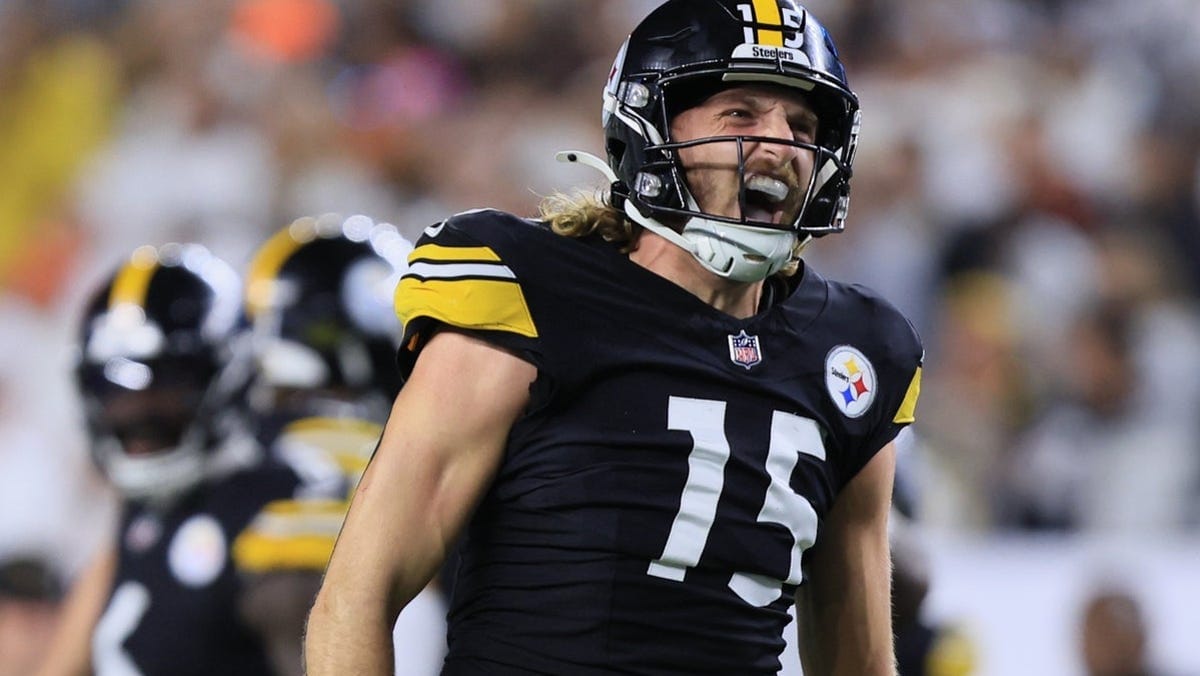
The Skowronek Conundrum: Information Warfare in a Fictional League
Let’s not get things twisted. The news about Ben Skowronek’s hand, or really, the lack of news about it, isn’t actually about Ben Skowronek at all. It’s about how the entire ecosystem of professional sports has devolved into a high-stakes information war, where the player himself is little more than a data point in a vast algorithm of strategic misdirection. A player like Skowronek—a serviceable, maybe even a necessary cog in the machine—is simply the sacrificial lamb on the altar of competitive advantage. The fact that he was sidelined for practice on Thursday only to have ‘no injury designation’ for Monday Night Football against Miami isn’t a miraculous recovery; it’s a cold, calculated move in a game of poker where the stakes are measured in millions of dollars and playoff implications. The idea that we, the spectators, are privy to real, verifiable information about a team’s health is a charming fantasy, one that allows us to believe in the integrity of the game while the people in charge are playing fast and loose with the truth.
The Strategic Imperative: Ambiguity as Power
When you look at the progression of the story—Skowronek (hand) sidelined at practice Thursday, then Skowronek (hand) has no injury designation for MNF—you’re not seeing a medical update. You’re observing the deliberate creation of ambiguity. In a league where every single detail is meticulously analyzed by opponents (and, perhaps more importantly, by a multi-billion dollar gambling industry), a team’s true health status is their most valuable asset. The Steelers’ coaching staff isn’t just trying to win a football game; they are trying to gain an edge by forcing the Dolphins to prepare for multiple contingencies. Does Skowronek’s hand injury affect his ability to block? Is it severe enough to limit his receiving routes? If the Dolphins have to waste even an hour of film study preparing for a healthy Skowronek, a limited Skowronek, and a completely absent Skowronek, that’s a small victory for Pittsburgh before a single snap has been played. It’s a classic example of creating uncertainty in a zero-sum game. The injury designation system, which was implemented ostensibly for transparency, has become the perfect tool for competitive misdirection. It allows teams to legally obfuscate reality under the guise of compliance.
This isn’t new; it’s simply a modern iteration of historical practices. Back in the day, before mandatory injury reports, teams would hide injuries entirely. Players would play through devastating injuries while the public remained completely oblivious. This led to a level of risk-taking that was, frankly, barbaric. The injury reporting system introduced in the 1970s was meant to curb this, to protect players and, later, to protect the integrity of the burgeoning gambling market. But human ingenuity, especially when motivated by competition and vast sums of money, always finds a loophole. The ‘Doubtful’ designation, the ‘Questionable’ tag, and now the strategic ‘no designation’ for a player who missed practice are all linguistic tools used to obscure rather than clarify. When a team designates a player as ‘Questionable’ all week and then he plays a full complement of snaps, it’s not a miracle; it’s a calculated decision to keep the opponent guessing. When a player misses practice and then suddenly has ‘no designation,’ it means one thing: the team wants you to think he’s fine, regardless of whether he actually is or not. The information provided is engineered for maximum strategic benefit, not factual accuracy. The simple truth is that we, as observers, are being fed a narrative that serves the interests of the team, not the interests of factual journalism. This isn’t reporting; it’s state-sponsored propaganda from the NFL itself.
The entire system operates under a principle known as ‘adverse selection.’ The teams that are most successful are often those that are most willing to manipulate information to their advantage. A coach who discloses the true severity of an injury might be seen as honorable, but he’s also seen as strategically weak. The pressure to win, combined with the immense financial and career incentives, ensures that the most aggressive and non-transparent strategies eventually prevail. This creates a feedback loop where ‘good faith’ reporting becomes a competitive disadvantage. The Skowronek situation is a microcosm of this systemic issue. The ‘hand’ injury in particular is interesting because it’s both highly impactful for a receiver/blocker and easily concealed. A hand injury can range from a minor sprain to a significant tear that severely limits a player’s ability to catch or maintain blocks. By giving no designation, the Steelers force Miami to prepare for the worst-case scenario (a fully effective Skowronek) even if he’s actually nursing something significant. It’s a classic misdirection play, executed not on the field, but in the media cycle.
The Economy of Scarcity: Player Value in the Information Age
The underlying dynamic here isn’t just about winning; it’s about the commodification of the athlete. Ben Skowronek, like every player in the league, possesses a specific market value. His health status directly impacts that value. When a player’s injury information is controlled, it’s not just strategic; it’s economic. The betting markets, which are now inextricably linked to the NFL, respond dramatically to injury updates. A small change in a player’s status can shift betting lines significantly, creating opportunities for arbitrage and manipulation. By withholding or massaging information about Skowronek, the team controls the flow of capital around the game. This isn’t just theory; it’s documented fact that professional sports teams, either directly or indirectly, benefit from maintaining favorable lines. The illusion of transparency keeps the market liquid and profitable, while allowing insiders to retain a distinct advantage. The fan, who might be placing a bet on a fantasy football lineup based on this information, is essentially a mark in a high-stakes con game. This creates an ethical gray area where a team’s actions are potentially influencing financial outcomes without full disclosure. We’ve seen examples of this in other sports where insider trading on injury reports has led to scandals. The NFL’s current system, far from preventing this, actually facilitates it by creating an environment where information asymmetry is not only tolerated but encouraged. The Skowronek report, in its brevity and contradictory nature, is a perfect illustration of this economy of scarcity.
The cold strategist looks at this situation and sees not a player’s pain, but a valuable asset that must be managed. Skowronek’s value extends beyond his physical contribution on Monday night. It includes his value as a strategic piece, a decoy, and a tool for creating uncertainty. The long-term implications for the player’s health are secondary to the short-term goal of winning the game. This dehumanization, where the athlete’s body is viewed purely as capital, is a defining characteristic of modern professional sports. The athlete’s long-term well-being is often sacrificed for the team’s immediate competitive needs. When a player plays through an injury that could have long-term consequences, it’s not just a sign of toughness; it’s a consequence of a system that demands immediate performance above all else. This isn’t to say Skowronek isn’t tough; it’s to say that his toughness is being weaponized by the system against himself. The ‘no injury designation’ effectively serves as a public mandate to play, removing any doubt about his availability and forcing him onto the field, even if he might benefit from extra rest. It’s a psychological tool as much as a medical one.
The Future of Information Control: Speculation and Cynicism
As we move into an era of advanced data analytics and real-time biometric tracking, the game of information control will only intensify. Teams will possess increasingly detailed knowledge about every player’s physical state—data on fatigue levels, recovery rates, and micro-injuries that are completely invisible to the outside world. This creates a new frontier for competitive advantage. The future of injury reporting won’t be about whether a player has a hand injury; it will be about precisely when and how to deploy information about that injury for maximum strategic leverage. We will see more sophisticated forms of misdirection, perhaps even ‘controlled leaks’ designed to influence betting markets or lull opponents into a false sense of security. The Skowronek incident, in its simplicity, offers a glimpse into this future. A small detail (a hand injury) is amplified and then retracted, creating a perfect strategic distraction. The media, eager for clicks, reports the update, effectively participating in the team’s information warfare without even realizing it. The cycle repeats, a perpetual feedback loop of manufactured uncertainty.
The cold strategist recognizes that in this environment, true transparency is dead. The entire system is built on a foundation of calculated half-truths. The players are pawns, the media are participants, and the fans are an audience for a meticulously choreographed performance. Skowronek’s hand injury is a perfect example of how the business side of professional sports prioritizes winning above all else, including honesty. It’s not a moral failure; it’s a strategic necessity within a hyper-competitive capitalist structure. The ‘no designation’ isn’t just about Ben Skowronek; it’s about the erosion of trust in sports and the triumph of strategy over transparency. The game against Miami will be played, but the real battle was already won when the injury report was released. This is how the modern game is played. (it’s a cynical masterpiece).