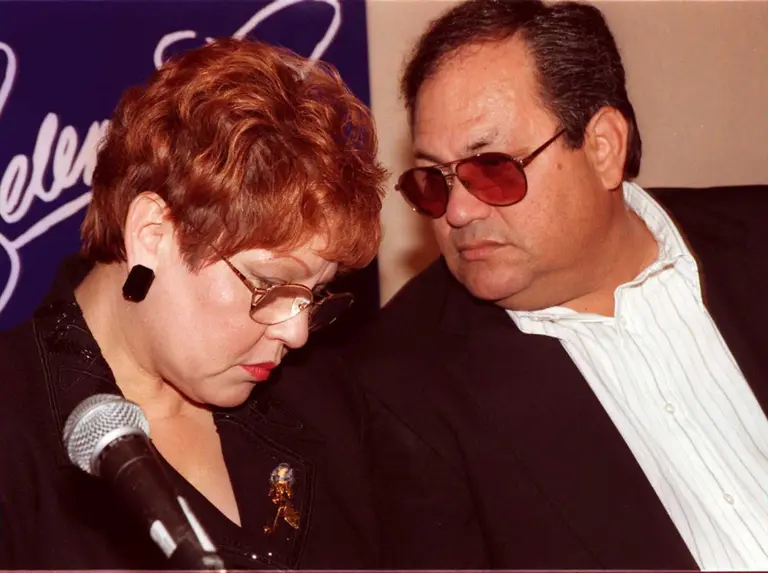
The Architect of an Empire Passes, Leaving Behind a Legacy of Control
It’s easy to write off the death of Abraham Quintanilla Jr. as a simple obituary. The father of a late, beloved singer dies at 86, and the narrative writes itself: a patriarch reunited with his daughter. But if you think for one second that this is just a family tragedy, you’re missing the point entirely. Abraham Quintanilla wasn’t just a father; he was the CEO of a multi-million-dollar industry built entirely on the memory of his deceased daughter, a meticulously managed empire where every single piece of memorabilia, every tribute concert, and every Netflix series was meticulously overseen, controlled, and monetized by him. He was the architect of Selena’s legend, but he was also the gatekeeper of her image, ensuring that the narrative remained exactly where he wanted it: profitable and sanitized.
Abraham’s passing doesn’t just mark the end of a life; it marks a massive shift in power dynamics for the Quintanilla brand. For three decades, he held the reins on an unparalleled cultural phenomenon. Now, that power vacuum leaves a glaring question: what happens to the golden goose now that its primary caretaker is gone? This isn’t about mourning; it’s about the future of a legacy, and whether new management will finally allow a more complex, honest narrative to emerge or if they’ll double down on the same old formula that made them rich.
The Myth of the American Dream and the Reality of Control
The story of Selena Quintanilla is often framed as the quintessential American Dream, a low-income family rising to fame through hard work and determination. That part is true, to a degree. But the narrative often glosses over the intense level of control Abraham exerted over his children’s careers from the very beginning. From forming the band ‘Selena y Los Dinos’ to dictating their musical direction (sometimes against their own wishes, particularly A.B.’s rock ambitions), Abraham was never just a manager; he was a benevolent dictator.
It worked, undoubtedly. His strategic vision took Tejano music out of a small regional scene and turned it into a crossover sensation that transcended language barriers. But success came at a cost. Selena’s identity was crafted to fit a specific image: innocent, hardworking, and perpetually smiling. The family business required total conformity, and that conformity continued long after her death. (In fact, a cynic might argue the control actually increased post-mortem, since the subject could no longer object.) The family’s ability to maintain this narrative, shutting down unauthorized projects and controlling everything from documentaries to action figures, speaks volumes about Abraham’s single-minded focus on legacy management.
Think about it: in 2024, nearly thirty years after her death, new Selena projects are still being released. This isn’t just a tribute; it’s a multi-generational business plan. And every dollar that comes in flows through the Quintanilla family structure. The passing of Abraham means that control now passes to his children, primarily A.B. and Suzette, who have been steeped in this very culture for their entire lives. The question isn’t whether the business will continue—it will—but whether the new regime will be more or less lenient with the narrative. My bet? Less lenient, if anything, because the stakes just got higher.
The Inevitable Power Vacuum and Internal Conflicts
When a family patriarch dies, especially one who built a financial empire, a power vacuum always emerges. In a typical scenario, we see factions emerge between siblings and relatives. The Quintanilla family has always presented a united front, but behind closed doors, a tight grip like Abraham’s often creates friction. We’ve seen glimpses of this in past interviews where A.B. Quintanilla has discussed the pressures of his father’s expectations and the burden of carrying the musical legacy. Now, he’s faced with actually running the ship without the captain’s guidance.
What’s the immediate effect? Expect a flurry of activity as different family members try to assert control over specific aspects of the business. The real estate holdings, the music rights, the merchandising deals—it all needs new leadership. Will A.B. and Suzette continue to work in harmony, or will the weight of the empire cause cracks to appear? The historical precedent for musical dynasties suggests internal strife is almost guaranteed. (Look no further than the Jackson family, where the legacy of Michael Jackson has been a source of near-constant legal battles among relatives.) Abraham kept a tight lid on dissent, but that lid just came off. The vultures, both inside and outside the family, are circling.
The Cost of Control: A Legacy Frozen in Time
One of the most profound effects of Abraham’s management style was the complete freezing of Selena’s identity at the point of her death. She remains, forever, the innocent 23-year-old star. While this creates a beautiful, idealized image, it simultaneously prevents any deeper exploration of who she truly was. We never see the complexity, the flaws, or the potential growth she might have experienced in her later years. It’s a calculated decision, designed to maintain a perfect, sellable product. The moment you introduce human complexity, you risk alienating the audience that wants a saint, not a person.
The family’s tight control over her image means we don’t have access to her personal journals, her unfiltered thoughts, or even a truly objective look at her life. (The 1997 movie and the Netflix series are both heavily curated by the family.) This isn’t inherently bad—it’s a form of legacy protection—but it does raise questions about truth versus myth. With Abraham gone, the new generation has to decide whether to continue this high-gloss, heavily filtered approach or allow a more realistic portrait to emerge. The business model strongly suggests they will stick to the high-gloss filter.
The Future of the Quintanilla Empire: A Reckoning or More of the Same?
The death of a figure like Abraham Quintanilla is more than just a headline; it’s a structural realignment. The Tejano industry, and the larger Latin music world, relied heavily on his business acumen and his connections. Now, the new generation has to step up. The most likely outcome is that A.B. Quintanilla and Suzette will consolidate control. They’ve been a part of this machine for decades, and they understand its mechanics perfectly. A.B. is already an accomplished musician and producer; Suzette manages the Selena Museum in Corpus Christi. They are prepared for this transition.
However, the question isn’t whether they can manage it, but how. Will they be able to maintain the level of control and business savvy that Abraham did? And will the next generation, Selena’s nephews and nieces, be as invested in maintaining the family business? This isn’t just about music anymore; it’s about real estate, merchandising rights, and media properties. The business model of profiting from nostalgia is finite; eventually, a new generation will emerge that doesn’t share the same emotional connection to the ’90s superstar. Abraham’s passing marks the transition from the generation that built the empire to the generation that must maintain it in a new, rapidly changing media environment where authenticity (or at least the illusion of it) is paramount.
Ultimately, Abraham Quintanilla’s passing is a moment for reflection on the fine line between protecting a legacy and profiting from a tragedy. He walked that line for 30 years with remarkable success. The future of the Quintanilla family business, and the perception of Selena herself, rests entirely on whether the new leadership can continue that tightrope walk without falling into the abyss of either irrelevance or pure, unadulterated exploitation.