
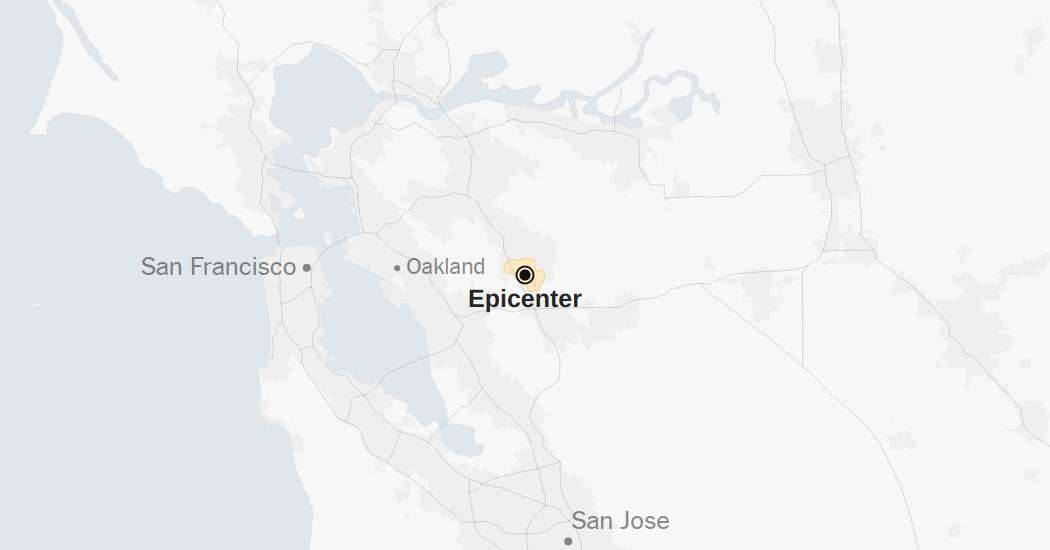
THE BAY AREA IS RUMBLING. THIS IS NOT A DRILL.
Let’s not mince words. The series of earthquakes that just hit Oakland and the East Bay—six of them in a single day, according to reports—is not just a little tremor to shake things up. It’s a geological warning. It’s the sound of the Hayward Fault clearing its throat before it swallowsings its final, destructive song. We’ve been told for decades that the Bay Area is living on borrowed time, that the ‘Big One’ is inevitable, and yet when the preliminary foreshocks start, everyone from city officials to tech-bro residents suddenly develops a selective hearing disorder, pretending everything is fine.
You see, the official narrative is always the same. “Magnitude 3.7. Minor damage. Nothing to worry about.” They want you to think it’s just the earth adjusting itself, releasing a little pressure, like a steam valve on a kettle. But that’s precisely where they’re wrong. A rapid-fire series of small quakes like this—what geologists often call a swarm—is exactly what a massive, locked-up fault looks like when it’s preparing to rupture. This isn’t stress relief; it’s stress concentration. This is the prelude to disaster, and nobody in power wants to admit it because panic would crash the housing market faster than a magnitude 7.5 earthquake would flatten the Transamerica Pyramid.
The Hayward Fault: A Ticking Time Bomb
Let’s talk history, because history has a nasty habit of repeating itself, especially when it comes to tectonic plates. The Hayward Fault is arguably the most dangerous fault in North America. Why? Because it runs directly through one of the densest urban centers in the country—Oakland, Berkeley, Hayward, Fremont. It’s not out in the middle of a desert like parts of the San Andreas. It’s literally under people’s houses and schools. The last major event on this fault, the 1868 earthquake, was estimated to be around a magnitude 7.0. The recurrence interval, the time between major earthquakes on this fault, is roughly 140 to 160 years. Do the math. We’re well past due. Every year that passes without a major quake only builds up more pressure, making the next one that much worse. And now we have a swarm. The clock is ticking, and we’re just playing a waiting game with fate.
When these small tremors happen, the natural human reaction is to sigh with relief that it wasn’t bigger. That’s a mistake. These are not isolated incidents. They are interrelated. Think about it: a small earthquake on one section of the fault transfers stress to an adjacent section. It doesn’t dissipate it entirely; it moves it. And when you have multiple small quakes hitting in quick succession, that’s a signal that the entire fault system is being agitated, that it’s reaching a critical point of failure. The ground beneath us is literally saying, “I can’t take this anymore.” It’s like pulling on a rope until the fibers start to snap one by one before the whole thing breaks.
The Unprepared City: From Liquefaction to Economic Collapse
The Bay Area, especially Oakland and San Francisco, has spent decades building on landfill and loose sediments. This creates a phenomenon called liquefaction during an earthquake. The ground turns to quicksand. This isn’t just about buildings shaking; it’s about buildings sinking. We saw a stark example during the 1989 Loma Prieta earthquake, when sections of the Marina District in San Francisco and certain areas in Oakland were completely destroyed by liquefaction. The fact that city planners continue to approve new high-rises and dense housing developments on these very vulnerable areas shows a level of civic negligence that borders on criminal. We’ve got billions invested in technology, in social media, in AI, but when it comes to basic structural integrity for a natural disaster we know is coming, we’re building castles on quicksand.
The economic impact of a major Bay Area earthquake would be devastating on a global scale. Silicon Valley is a hub for international finance and technology. A magnitude 7.0+ quake would shut down data centers, sever fiber optic cables, and completely halt a significant portion of the global economy. The ripple effect would be felt in Tokyo, London, and New York. The insurance industry would collapse under the weight of claims. The damage estimates for a major Hayward Fault event run into the hundreds of billions, not just because of property damage, but because of the cascading failure of infrastructure and business operations. And yet, we continue to act like this is a low-probability event, when the geological data screams otherwise.
The Domino Effect: From Hayward to San Andreas
It’s not just the Hayward Fault we have to worry about; it’s the interconnected system of faults in California. The San Andreas Fault, the one everyone thinks about, runs parallel to the Hayward Fault. A major rupture on one can trigger a major rupture on another. The stress transfer is real. We are talking about a potential domino effect that could unleash a truly catastrophic event. The small quakes we’re seeing in Oakland might be small in magnitude, but they are massive in implication. They are the initial cracks in the dam before the floodgates open completely.
The authorities will tell you to be calm. They’ll tell you to download a preparedness app, keep water in your garage, and go about your day. They are actively trying to suppress panic because a panicked populace is bad for business and for their political careers. But real preparedness isn’t about having a little emergency kit; it’s about understanding that the very ground beneath your feet is unstable. It’s about recognizing that these small tremors are the final countdown. We are in the pre-disaster phase, and anybody who tells you different is either lying to you or in denial. The question isn’t if the big earthquake will happen, but how much longer we have until it does, and these recent quakes are telling us the answer: not long at all long.
What Now? Panic or Preparedness?
For those living in the East Bay, this isn’t a time for complacency. It’s time to realize that the risk is higher than ever before. The structural integrity of older buildings in Oakland, especially those built before modern seismic codes, is questionable at best. We have seen what happens in other places—Turkey, Mexico City—where small quakes lead to bigger ones. The pattern is consistent. We ignore it at our peril. These recent small quakes are not anomalies; they are indicators. They are a sign that the seismic plates are shifting into their final positions before the big event. We can either listen to the warnings or choose to be caught completely off guard when the inevitable happens.
It’s a terrifying thought, but it’s one we must face head-on. The series of quakes in Oakland is a clear signal that the Hayward Fault is reaching its breaking point. This isn’t just news; it’s a call to action. We need to demand real infrastructure investment, enforce strict building codes on all structures, and stop pretending that a few small tremors are harmless. They are not harmless. They are warnings. The earth is talking, and we must listen, because the next time it speaks, it may be too late to do anything but hang on for dear life.
Photo by Makalu on Pixabay.