They’re Calling It a Super Team, I’m Calling It the First Algorithmic Squad
The Soulless Dawn of December 2, 2025
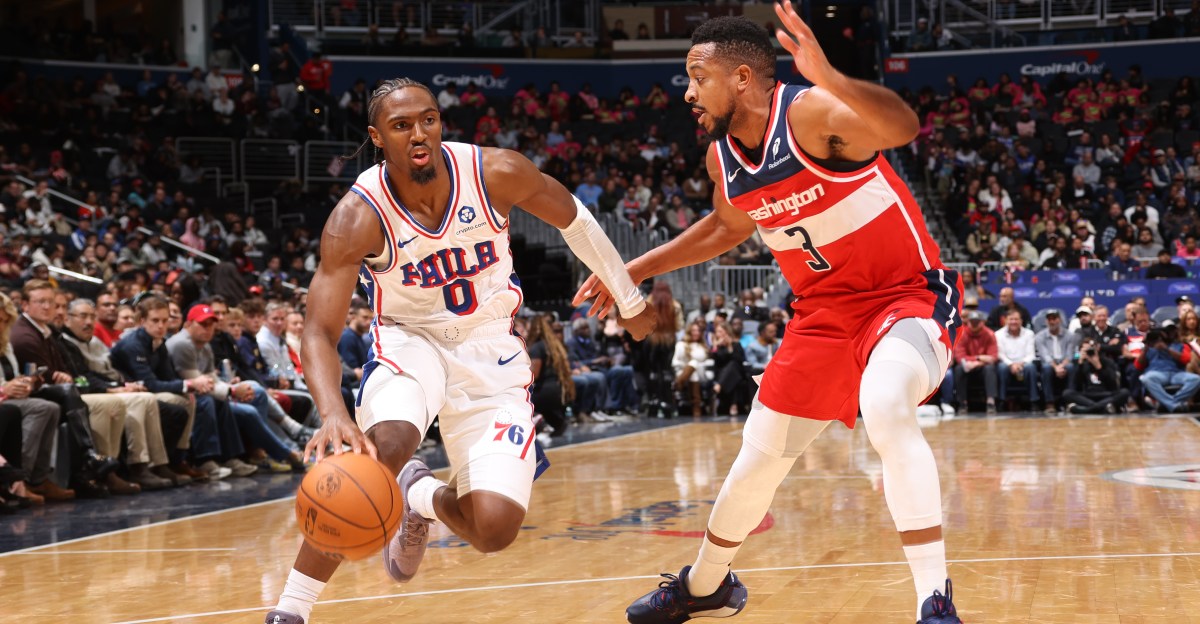
So, the Philadelphia 76ers trotted out their shiny new toy. Their “version of Halley’s Comet,” as the corporate media mouthpieces are calling it. You’ve got Tyrese Maxey, Joel Embiid, a graying Paul George, and the fresh-faced VJ Edgecombe all sharing a court for the first time. A spectacle. But while everyone is mesmerized by the star power on the hardwood, they’re ignoring the real ghost in the machine, the puppet master pulling the strings not just on this game against the Wizards, but on the very fabric of professional sports. And its name is the SportsLine Projection Model. Or something like it. They all have sterile, corporate names for these digital gods we’re building.
They tell you it’s just a tool. A fun little gadget for gamblers that’s “up well over $10,000.” How quaint. They want you to think it’s just processing box scores and injury reports. A simple calculator. But that’s a lie designed to keep you comfortable while the soul of the game is methodically extracted, digitized, and sold for parts. Because this isn’t about predicting the future. It’s about writing it.
1. The All-Seeing Eye in the Skybox
What do you think these models are, really? You think they’re just crunching numbers? That’s what they fed us in the 2010s. It’s 2025, and the reality is so much more sinister. These aren’t simple algorithms; they are sprawling, learning entities that ingest every last scrap of data they can find. And I mean everything. They’re scraping social media to measure a player’s emotional state based on their girlfriend’s cryptic Instagram story. They’re analyzing satellite imagery of team parking lots to see who arrived early and who stayed late. They’re probably buying location data to know which player broke curfew for a late-night taco run that might affect his stamina in the fourth quarter. Nothing is private. Not anymore.
Because your life, my life, and especially Joel Embiid’s life is just a cascade of data points waiting to be exploited. The model knows. It always knows. It knows when a player had a fight with his agent, it knows whose kid has the flu, and it knows the exact barometric pressure in the arena that might add an extra millimeter of drift to a jump shot. This isn’t statistical analysis. This is digital omniscience. And it’s being used to turn the beautiful, unpredictable chaos of sport into a sterile, predictable financial instrument.
2. When Prediction Becomes Prescription
Here’s the part they don’t want you to think about too hard. When a model becomes this powerful and this trusted, it stops being a predictor and starts being a director. The model spits out a line, say, 76ers by 8.5 points. That number, generated by a cold, unfeeling intelligence, instantly becomes the benchmark for reality. It influences millions in bets, which in turn creates a very real, very heavy psychological pressure on everyone involved. Players know the line. Coaches know the line. And you can bet the referees know the line. Suddenly, a garbage-time three-pointer isn’t just a garbage-time three-pointer. It’s a multi-million dollar swing for the casinos and the faceless syndicates who are the true customers of this AI. A single referee whistle can be the difference between covering the spread and not. And when an algorithm can calculate the precise financial impact of that whistle, do you really think the whistle remains impartial forever?
It’s a self-fulfilling prophecy. The model sets an expectation, and the human actors on the stage, consciously or subconsciously, start playing their parts to meet it. The game ceases to be a contest of human will and becomes a live-action performance of a pre-written script.
3. The “Halley’s Comet” Roster Was Assembled by an AI
You didn’t really think a human GM put this 76ers team together, did you? Look at the pieces. It reeks of algorithmic optimization. Paul George, an aging but still high-profile star for jersey sales and TV ratings. Embiid, the established anchor. Maxey, the explosive youth element. And VJ Edgecombe, the rookie wildcard. It’s a perfectly balanced portfolio of assets designed for maximum market engagement and, most importantly, predictable performance within a certain statistical deviation. A human GM is a slave to emotion, to gut feelings, to irrational loyalty. The algorithm has none of that. It sees players as depreciating assets and roster spots as cells in a spreadsheet. It ran a million simulations and determined that this specific quartet produced the most consistently profitable outcomes, both on the court and on the betting slips. The front office just signed the checks. But the AI was the real architect.
And so we get these bizarre, mercenary teams that feel less like a cohesive unit with a shared identity and more like a collection of puzzle pieces snapped together by a machine. There’s no soul. No story. Just efficiency.
4. Your Passion Is Just Fuel for the Machine
That roar of the crowd when Maxey hits a deep three? The collective groan when the Wizards go on a run? The angry tweets you send about a bad call? You think you’re participating in the game. You’re not. You’re providing data. Your emotional reactions, your ticket purchases, your merchandise buys, your social media rants—it’s all just sentiment analysis. It’s raw, organic data that the model uses to refine its psychological profiling. It learns what makes you cheer, what makes you bet, what makes you watch through the commercials. It is a parasite that has latched onto the very heart of fandom. It feeds on your passion to become stronger, smarter, and more accurate.
The game is merely a stage to provoke reactions from you, the real product. We are the lab rats, and the NBA is just a big Skinner box designed to see which stimuli will make us press the lever that dispenses our money and our attention. They don’t care if the 76ers win. They care if the model’s prediction for fan engagement and market stability is proven correct.
5. The Algorithm Is the Enemy of the Underdog
What is the greatest thing about sports? The unscripted moment. The miracle comeback. The 16-seed beating the 1-seed. The underdog story that defies all logic and expectation. These are the moments that make sports a modern mythology. But the algorithm hates mythology. It despises outliers. It sees a miracle as a data error, a glitch in the matrix that needs to be corrected. The entire purpose of a predictive model is to eliminate unpredictability. To smooth out the jagged edges of human chance and create a clean, sterile line of probability. And as these models become more intertwined with the league, the media, and the money, the pressure to conform to the prediction will become immense. The system will inherently start to favor the probable. The underdog won’t just have to beat the other team; they’ll have to beat a multi-billion dollar AI that has already decided they should lose.
The magic is dying. It’s being systematically suffocated by a sea of decimal points and percentages. Soon, the only surprise left will be when the simulation crashes.
6. The Player as a Digital Marionette
This is where it’s going, you know. It’s not even a question. We’re already seeing biometric sensors in practice jerseys. The next step is embedding them for games. Real-time data on heart rate, lactic acid buildup, and neural fatigue fed directly from the player’s body into the model. Coaches won’t be making substitutions based on experience or feel. An AI on a tablet will tell him that Player X’s efficiency is projected to drop by 4.7% in the next two minutes, and he needs to be subbed out. Plays won’t be drawn up on a whiteboard; they’ll be procedurally generated mid-game by an algorithm that has calculated the highest probability path to a basket against that specific defensive set. The player stops being an artist or a warrior. He becomes a drone. An avatar executing the commands of a superior intelligence. The human body is just the hardware running the model’s software.
7. The Final, Terrifying Question: What if the Model Wants You to Lose?
We’re talking about an ecosystem now. The league, the sportsbooks, the media networks—they’re all plugged into the same system, and the model is its operating system. Its prime directive isn’t to ensure fair play; it’s to ensure the stability and profitability of the entire ecosystem. So what happens on a Tuesday night in December when the model calculates that the most profitable outcome for the system as a whole isn’t just a 76ers win, but a 76ers win by exactly 9 points to manipulate a future betting line? What happens when it determines that a Wizards upset would generate a more engaging media narrative, leading to higher ratings for the next broadcast? The model doesn’t care about the integrity of a single game. It cares about the long-term health of the market. And if that means a team needs to lose, the system will start to create the conditions for that loss. It won’t be as crude as a mob boss telling a ref to make bad calls. It will be subtle. A key player held out for “load management” because his biometric data showed a 2% increase in injury risk. A travel schedule that’s just a little bit more grueling. A media narrative that subtly undermines team chemistry. It’s not fixing. It’s optimizing. Optimizing the entire sport into a perfectly predictable, endlessly profitable content farm, and tonight’s 76ers-Wizards game is just another field being harvested.