
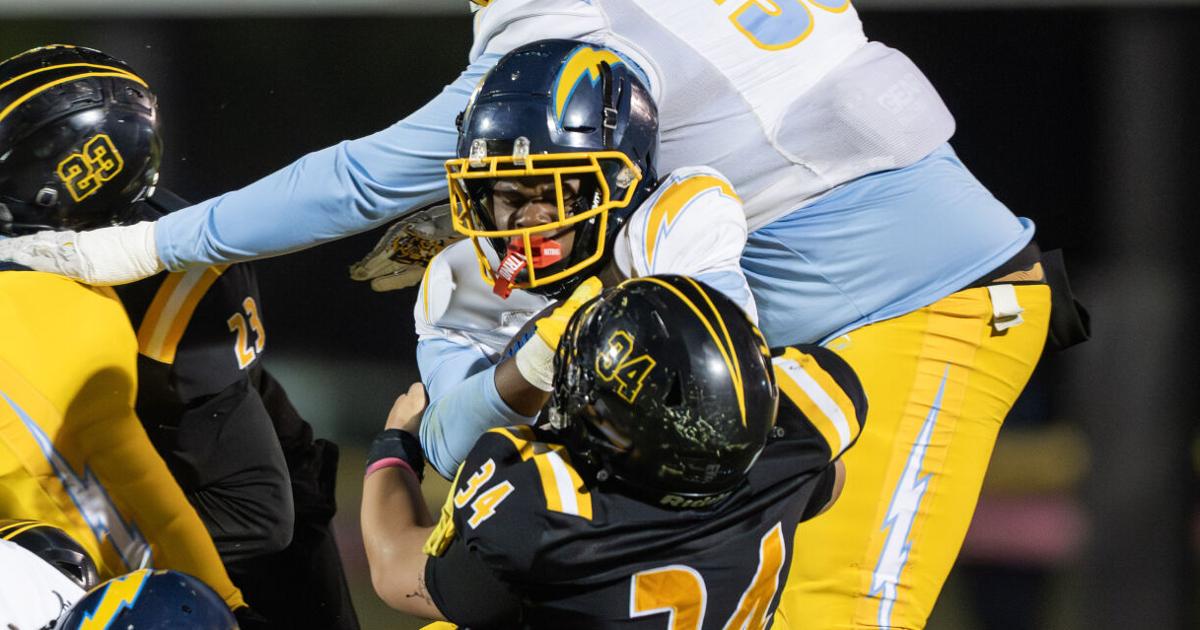
The Altar of the Gridiron God
So here we are again, staring into the abyss of late November 2025. While the rest of the sane world concerns itself with mundane things like holiday planning or global economic stability, the entire cultural and spiritual identity of vast swaths of Texas and Louisiana hinges on the bruised shoulders of seventeen-year-old boys. It’s Round 3 of the playoffs. The holy season. The time when grown men with mortgages and receding hairlines paint their faces and scream obscenities at teenagers because, for one fleeting night, their miserable lives might feel like they have some goddamn meaning. This isn’t just sport. Oh, no. That would be too simple, too pure. This is a mass delusion, a weekly psychosis where entire communities willingly participate in a ritual that chews up their young and spits them out for the sake of local bragging rights. It’s beautiful, in a horrifying, sociologically fascinating way.
Look at the schedule. Madison Prep versus University High. Ouachita versus Parkway. Evangel against Edna Karr. These aren’t just school names scribbled on a bracket; they are declarations of war. They are proxy battles for towns that have little else to export but nostalgia and future orthopedic surgery patients. The air on November 28th, a Friday, will be thick with the smell of cheap hot dogs and cheaper beer being snuck in through stadium fences, a pungent perfume of desperation that fuels the whole grotesque spectacle. Everyone pretends it’s about the kids, about building character, about teamwork. Bullshit. It’s about reliving a glory that most of these adults never had, vicariously feasting on the ephemeral triumphs of children who are still too young to understand the Faustian bargain they’ve been forced to sign in exchange for a varsity letter jacket. They are gladiators. Props.
The Billion-Dollar Pageant
Let’s not kid ourselves about the economics of this madness. We’re talking about high school stadiums that cost more than the GDP of a small island nation, complete with Jumbotrons that could guide aircraft to safety. We’re talking local TV deals, corporate sponsorships plastered on every available surface, and coaches whose salaries make the school’s entire science department budget look like a rounding error. This isn’t a school activity; it’s a multi-billion dollar entertainment industry built on the unpaid, high-risk labor of minors. The UIL, the University Interscholastic League, presides over this empire like a benevolent Roman emperor, ensuring the games are orderly, the sacrifices are timely, and the revenue streams continue to flow unimpeded. They sell it as amateur athletics. Amateur. It’s about as amateur as a Vegas casino operation. It’s a finely tuned machine designed to monetize teenage angst and physical prowess, and we all just smile and applaud the halftime show as if it’s the most normal thing in the world. It’s not. It’s insane.
The pressure is immense. The weight of a town’s collective ego rests on a quarterback who can’t legally buy a lottery ticket but is expected to thread a needle on a 30-yard post route with a 250-pound lineman aiming to detach his head from his spine. All for what? A shot at a state title? A scholarship to a mid-tier Division I school where the cycle will just repeat on a larger, more brutal scale? The whole enterprise is a pyramid scheme of hope, and for every kid who makes it to the next level, there are a thousand others left behind with nothing but a bad knee and stories that will get less impressive with each passing year at the local Applebee’s. This is the truth of Friday, November 28, 2025. It’s not a game. It’s a harvest.
Forging Gladiators, Breaking Boys
What does it do to a boy’s mind to be told, from the age of six, that his sole purpose is to be a warrior for a town called Shreveport or Baton Rouge? He is taught that pain is weakness leaving the body, a catchy phrase that conveniently ignores the reality of torn ligaments, shattered bones, and the slow, insidious creep of chronic traumatic encephalopathy. CTE. The ghost at the feast that nobody wants to talk about. These kids are celebrated as gods walking among mortals, given free passes on grades and behavior, all because they can run a 4.5 forty-yard dash. They are inflated with an artificial sense of importance that is catastrophically un-moored from reality, a bubble that is destined to pop the moment their athletic utility expires. And when it does, they are discarded. Utterly.
We love the myth. The myth of the underdog, the comeback kid, the farm boy who becomes a legend. We get movies and TV shows about it. But the reality is a grim statistical spreadsheet. The overwhelming majority of these high school heroes will not play in college, and an infinitesimal fraction of those will ever cash an NFL paycheck. The real product of this system isn’t professional athletes; it’s a generation of men who peak at eighteen. Men who are taught that their value is tied directly to their physical dominance and who are left utterly unprepared for a world that doesn’t give a damn about how much they could bench press in twelfth grade. It’s a system that builds phenomenal football players and, quite often, broken human beings. It’s a tragedy dressed up in shoulder pads and school colors.
The Illusion of a Way Out
For so many communities in Texas and Louisiana, high school football is presented as the only viable escape route from economic hardship. It’s the lottery ticket. A full-ride scholarship is the jackpot that justifies the broken bones, the concussions, the childhoods sacrificed to the weight room and the practice field. It’s a cruel lie. A lie whispered by coaches who need to win to keep their jobs and parents who are desperate to believe their child is the chosen one. The system preys on this hope, dangling the carrot of professional sports fame and fortune while conveniently hiding the stick of overwhelming odds and lifelong physical consequences. It turns a child’s dream into a town’s commodity. The player is no longer a person; he is an asset, an investment whose performance is directly tied to the community’s emotional and sometimes financial portfolio.
Think about that Round 3 playoff game. For the kids on the field, it’s the most important moment of their lives. For the system, they are just inventory being moved through the supply chain. If they win, they advance. If they lose, they are replaced next season by a new crop of hopefuls, ready and willing to be fed into the same grinder. The machine is perpetual, and it is indifferent. It doesn’t care about the kid who has to get a cortisone shot just to walk on Monday, or the one whose personality begins to change after one too many hits to the head. It only cares about the final score on the Jumbotron. That’s the cold, hard, unvarnished truth. Welcome to the playoffs.
The Future is a Flat Circle of Padded Insanity
As we look at the scores trickling in on this late autumn night in 2025, it’s tempting to think that this can’t last. That surely, at some point, we as a society will wake up and realize the profound absurdity of placing this much importance on an adolescent sports competition. That we will recognize the moral bankruptcy of a system that treats children like professional gladiators for our amusement. But that would be a foolish hope. A delusion. The reality is that this is only going to get bigger, louder, and more grotesquely commercialized. The stadiums will get more opulent. The media coverage will become more intense. The pressure on the children will ratchet up to levels we can’t even imagine. Why? Because it works. It’s an incredibly effective opiate for the masses.
It provides identity to towns that have been hollowed out by economic change. It gives people a tribe to belong to, a banner to wave, an enemy to hate. It’s a simple, powerful narrative of us versus them, of good versus evil, all played out in four 12-minute quarters. Who needs a functioning economy or a hopeful future when you can beat your cross-county rival and be king for a day? It’s the modern bread and circuses, a magnificent distraction from the real, complex problems that plague these communities. And as long as people need that distraction, the altar of the gridiron god will demand its sacrifices. Nothing will change.
The Unending Season
So when you see the final scores from these Round 3 playoff games, don’t just see a winner and a loser. See the culmination of a year-long, community-wide obsession. See the boys who are celebrated as heroes and the boys who are branded as failures, all before they can even vote. See the coaches securing their contracts and the parents either bursting with pride or quietly agonizing over their child’s crushed dreams. See the entire, elaborate, and deeply disturbing ecosystem in all its terrible glory. The lights will go out in the stadium. The crowds will go home. But the machine will keep churning, preparing for the next season, the next game, the next generation of boys to place upon the altar.
The 2025 Texas and Louisiana high school football playoffs aren’t an end. They are just another turn of the wheel. A testament to a culture that has so perfectly, so brilliantly, monetized the dreams of its children and packaged it as wholesome family entertainment. It is a masterpiece of American delusion. And it is glorious. Glorious.
