1. Deconstructing The 18-1 Illusion
And so the narrative is set. The Oklahoma City Thunder, heralded with an almost mythical 18-1 record and the aura of a defending champion, stand as the league’s new titans. But a strategist does not deal in narratives; a strategist deals in probabilities and pressures. The 18-1 figure, factually incongruous with reality, is not a statistic but a weapon of psychological warfare, a media-forged crown placed upon a young king’s head before he has ever seen a true battlefield. This perception is far more dangerous to OKC than it is to Phoenix. Because it creates an expectation of perfection that is unsustainable, a pressure vessel waiting for a crack. For the Phoenix Suns, this is not a ‘great test’ against an unbeatable foe; it is an opportunity. An opportunity to be the pin that pops the balloon.
The Weight of a False Crown
The Thunder are not the defending champions; the Denver Nuggets hold that distinction. This factual error in the prevailing discourse is telling, revealing a collective desire to anoint a successor before the throne is even cold. And the 18-1 record, while a symbol of their brilliant start, becomes an anchor. Every possession, every play is now weighed against that impossible standard. Young teams thrive on momentum and freedom, but they crumble under the burden of being the designated Goliath. Phoenix, on the other hand, enters this contest with nothing to lose and everything to prove. They are the grizzled veterans, the hired guns assembled for a singular purpose, and the market has already branded them as talented but flawed underachievers. This underdog status, manufactured or otherwise, is a strategic asset. It allows them to play loose while OKC must play tight, protecting a reputation they haven’t truly earned yet.
2. The SGA Fulcrum: A System’s Strength and Weakness
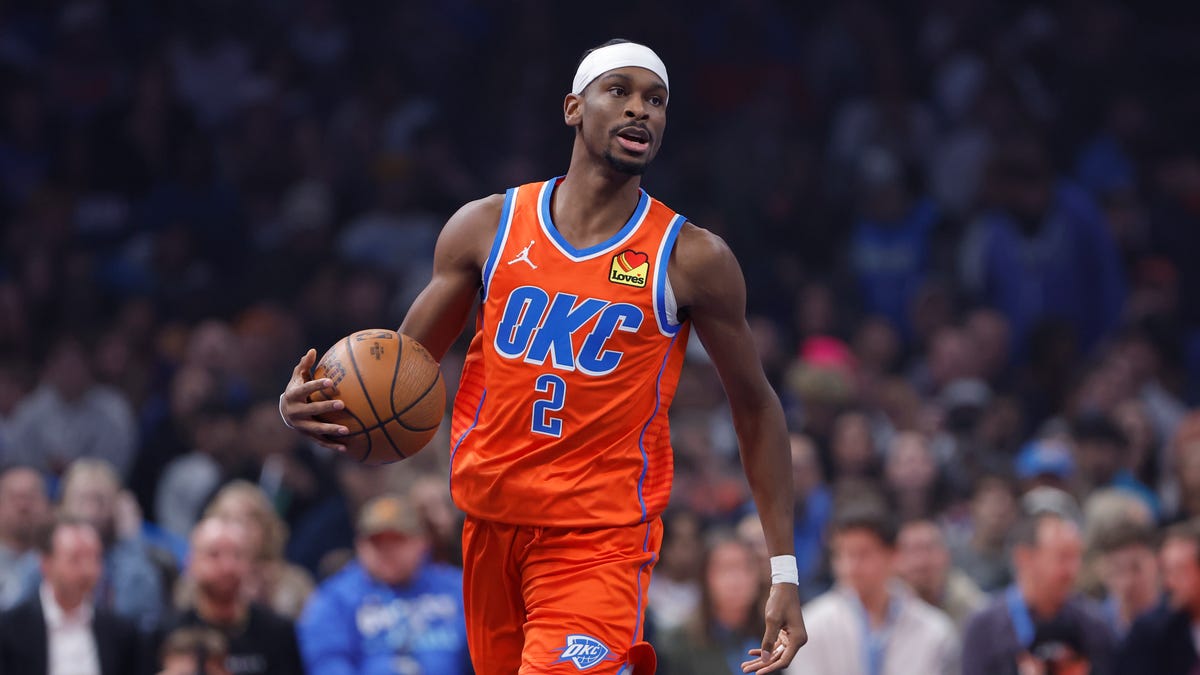
Shai Gilgeous-Alexander is not merely a player; he is an operating system. His deliberate, herky-jerky drives and mastery of the midrange are the central processing unit for everything Oklahoma City accomplishes on offense. The entire architecture of their attack is built around his ability to manipulate defenses, create fissures, and either exploit them himself or generate open looks for his teammates. He is, without question, an MVP-caliber force whose gravitational pull defines the geometry of the court. And this is precisely where the strategic vulnerability lies. Because any system that relies so heavily on a single fulcrum can be dismantled if you can successfully disrupt that central point. It is a classic military doctrine: neutralize the command and control, and the army falls into disarray.
Isolating the Engine
The Suns’ defensive game plan, engineered by a mind like Frank Vogel’s, will not be to simply ‘stop’ SGA. That is a fool’s errand. The plan will be to dictate the terms of his engagement. It will involve funneling him into predetermined spots on the floor where help is strategically positioned, forcing him to make decisions a half-second earlier than he prefers. It will mean using length—from Kevin Durant, from Royce O’Neale, from any available wing—to contest his airspace, not just at the rim but in his midrange comfort zones. The objective is to make every one of his brilliant calculations just a little bit harder, to introduce a margin of error into his flawless machine. If the Suns can force SGA into being a volume scorer rather than a systemic engine, they will have won the strategic battle, even if he still scores 35 points. The goal is to sever his connection to the rest of the system.
3. The Phoenix Gambit: A Trio of Offensive Overload
The Phoenix Suns were not constructed for sustainability; they were constructed for overwhelming force. The assembly of Kevin Durant, Devin Booker, and Bradley Beal is a high-risk, high-reward gambit predicated on a simple, brutal hypothesis: you cannot have enough defenders to neutralize all three. On any given night, this trio represents the most potent concentration of offensive firepower in the entire league. It is a strategic checkmate in theory. But the reality has been far more complicated. Injuries have created a lack of cohesion, a disjointedness that has prevented this theoretical supernova from reaching its full explosive potential. This game against OKC is not just a test of their talent, but a test of their synergy against a young, disciplined, and elite defensive unit. It’s a proving ground for the entire premise of their roster construction.
Chemistry as a Weapon
But the narrative of their disjointedness can be misleading. Because what they may lack in months of shared court time, they compensate for with sheer basketball intelligence. Durant, Booker, and Beal are not just scorers; they are students of the game who understand spacing and leverage at an almost cellular level. Their challenge is not in learning to play together, but in accelerating that process under playoff-like intensity. This game is that accelerator. A win against the league’s media darlings would do more for their internal chemistry and external validation than a dozen wins against lottery teams. It would prove the gambit was sound. A loss, however, would amplify the whispers that this collection of stars is just that—a collection, not a unit. It’s a high-stakes play.
4. The Chess Match: Vogel’s Defensive Doctrine vs. Daigneault’s Innovation
On the sidelines, this is a fascinating clash of philosophies. In one corner, you have Frank Vogel, a strategist who has won a championship on the bedrock of defensive discipline. His entire career is a testament to the idea that organized, physical, and intelligent defense is the foundation upon which titles are built. He sees the game as a series of problems to be solved through structure and execution. In the other corner stands Mark Daigneault, the architect of this new-age Thunder team. He represents a more fluid, modern approach, one that prioritizes versatility, spacing, and a relentless, positionless attack. He is the innovator, the tactician who has turned a collection of young assets into a cohesive and dangerous machine. This matchup is a referendum on which philosophy holds more weight in the modern NBA: the time-tested principles of a defensive veteran or the cutting-edge concepts of a rising innovator.
Experience as a Tactical Edge
And while Daigneault’s system is brilliant, Vogel’s experience in high-stakes environments is an intangible asset that cannot be replicated in practice. Vogel has guided teams through the crucible of the NBA Finals. He understands the psychological ebb and flow of a 48-minute battle against an elite opponent. He knows how to make adjustments on the fly, how to manage egos, and how to instill defensive resolve when the offense goes cold. Daigneault is a phenomenal coach, but he is leading a team that has not yet faced true, sustained adversity. Vogel’s entire strategy will be to create that adversity, to throw tactical wrenches into OKC’s beautiful, free-flowing machine and see how the young innovator and his even younger team respond. It is the old bull versus the young calf.
5. The Battle in the Trenches: Nurkić and Holmgren
So much of the focus will be on the perimeter stars, but the strategic fulcrum of this game could very well be the clash of styles in the paint between Jusuf Nurkić and Chet Holmgren. They are perfect foils for one another. Holmgren is the future: a slender, skilled big man who can protect the rim, stretch the floor with his shooting, and handle the ball like a guard. He is the ultimate modern center, a lynchpin in OKC’s five-out offensive scheme and a defensive eraser. Nurkić, by contrast, is a throwback. He is a physical, bruising presence, a master of positioning, screening, and rebounding who uses his bulk and craftiness to create space and punish smaller opponents. He is the anchor that allows Phoenix’s perimeter players the freedom to operate. This is not just a matchup of players; it is a matchup of eras.
Exploiting the Unconventional
The key question is who can impose their will more effectively? Can Holmgren’s length and skill draw Nurkić away from the basket, opening up driving lanes for SGA and Jalen Williams? Or can Nurkić’s sheer physicality wear Holmgren down, dominate the offensive glass, and force OKC’s defense to collapse, thereby creating open looks for Durant and Booker? The Suns’ most viable path to victory involves leveraging Nurkić’s old-school strengths against Holmgren’s primary weakness: his slender frame. If Nurkić can establish deep post position and get Holmgren into early foul trouble, it completely alters the geometry of OKC’s defense. It is the Suns’ most significant, if unglamorous, strategic advantage.
6. The In-Season Tournament: A Meaningless Trophy or a Strategic Proving Ground?
One cannot ignore the context of this game: it is a pivotal matchup in the inaugural NBA Cup. For many, this tournament is a novelty, a transparent cash grab with a garish court design. A meaningless distraction. But from a strategic perspective, that is a naive interpretation. For a young, ascending team like the Thunder, the tournament represents a low-stakes opportunity to experience a high-stakes environment. It’s a dress rehearsal for the playoffs, a chance to test their mettle in games that have a tangible, immediate reward. It allows them to build winning habits and a clutch reputation. They have every incentive to treat this game with the utmost seriousness.
Veteran Apathy vs. Youthful Hunger
For a veteran-laden team like the Suns, however, the calculation is different. Their eyes are on a much larger prize: the Larry O’Brien Trophy in June. The NBA Cup is, at best, a secondary objective and, at worst, an injury risk. Does this create an effort disparity? Perhaps. But a cold strategist would argue the opposite. The Suns, plagued by questions of chemistry and consistency, need these high-intensity moments more than anyone. This is not just a tournament game; it is a chance to forge their identity against the best. A chance to silence the doubters and, more importantly, to prove to themselves that their grand experiment can actually work. For Phoenix, the context is less about winning the Cup and more about using the Cup as a crucible to become the team they were designed to be.
7. The Long Game: A Single Battle in a Protracted War
And so we arrive at the final calculation. This is more than a single game on a Tuesday in November. It is the opening salvo in what could be a long and fascinating strategic conflict in the Western Conference. A win for Oklahoma City validates their meteoric rise. It solidifies the narrative that they are not just the future, but the present. It sends a shockwave through the conference, forcing every other contender to recalibrate their assessment of the league’s power structure. It would be a massive psychological victory. A win for Phoenix, however, is arguably more significant. It serves as a powerful counter-narrative. It re-establishes the old guard, a reminder that talent and experience still hold immense value. It exposes the first crack in the Thunder’s immaculate armor and plants a seed of doubt. It says, ‘Not yet.’ This game sets the tone for every future encounter, including a potential playoff series where the psychological scars of this first battle could prove decisive. The stakes are, therefore, immense. It’s not about one win. It’s about seizing control of the story.